
Citrus leprosis
Cilevirus leprosis
Description
Symptoms
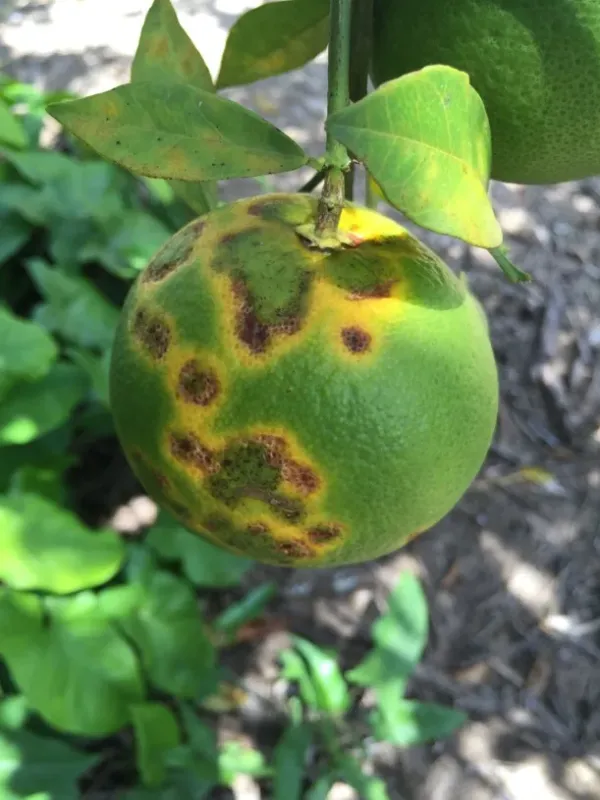
The main signs of Citrus leprosis include characteristic spots on leaves, twigs, and fruits. Initially, these appear as chlorotic lesions, which later develop into brown or dark necrotic spots with a yellow halo.
On fruits, the infection manifests as necrotic areas, causing fruit deformation and premature drop. This renders the harvest commercially unmarketable and unsuitable for any processing.
Twigs show significant deformation, with bark cracking and dieback occurring at the sites of infection. In severe cases, the tree sheds its leaves prematurely, leading to overall canopy thinning.
Symptom severity depends on the host citrus variety and the tree's age. It is essential to carefully inspect the underside of leaves and fruit peduncles where the mite vectors are typically found.
Early diagnosis is often difficult due to the resemblance of symptoms to other fungal or bacterial diseases. Laboratory testing via PCR is necessary to accurately confirm the presence of the virus.
Pathogen
The causative agent of the disease is a virus from the Cilevirus genus. It has a very narrow host range, primarily infecting citrus plants within the Rutaceae family.
The virus localizes within the epidermal and parenchyma cells, causing tissue death and necrosis. It is not transmitted mechanically through pruning tools, unlike many other plant viruses.
The biological cycle of the virus is inextricably linked to the mite vector, specifically the false spider mites of the genus Brevipalpus. These mites are the sole agents of transmission.
Viral replication occurs within the mite's body after it feeds on infected tissue. The latent period within the plant can range from several weeks to months before symptoms become visible.
Genetic diversity within the Cilevirus group poses a challenge for breeders aiming to develop resistant citrus cultivars. Consequently, managing the vector population is the primary strategy for disease control.
Conditions for development
The prevalence of Citrus leprosis is directly correlated with the population density of Brevipalpus mites. Warm and humid climates provide ideal conditions for the rapid multiplication of these vectors.
High-density planting and a lack of proper canopy pruning create microclimates that are perfect for mite colonization. In such environments, the virus spreads rapidly across the entire orchard.
Optimal temperatures for mite development range between 25 and 30 degrees Celsius. During these peak periods, the risk of a disease outbreak increases significantly.
Excessive weed growth in orchards provides a reservoir for mites, facilitating their migration onto citrus trees. Keeping the orchard free of weeds is a critical component of disease management.
Poor aeration and limited light penetration inside the canopy create stagnant zones with higher humidity, where mite populations thrive undisturbed by sunlight or chemical sprays.
Why it matters
The primary economic threat of Citrus leprosis is the drastic loss of fruit yield and the eventual degradation of the trees. Infected trees lose vigor, become weak, and are prone to secondary infections.
Financial losses occur due to the total loss of fruit marketability and the high costs associated with removing and replacing devastated orchard sections.
The disease reduces the photosynthetic capacity of the tree by damaging the leaves, which causes stunted growth and the tree's inability to produce high-quality buds or future harvests.
Long-term infection leads to the death of primary branches and eventually the whole tree. In large commercial orchards, this necessitates expensive and total block removal.
As a quarantine-regulated disease, an outbreak can lead to strict trade restrictions. This blocks the export of citrus products, causing significant economic damage to the region's agricultural industry.
Protection
The primary control method is the rigorous management of the Brevipalpus mite population using acaricides. Without effective vector control, managing the viral infection is impossible.
Regular orchard monitoring is essential; growers should use magnifying lenses to inspect leaves for mite presence. Early intervention with appropriate chemicals can prevent massive outbreaks.
Sanitary measures include the pruning and immediate burning of heavily infested branches to reduce the inoculum level in the orchard.
- Application of effective acaricides specifically targeting Brevipalpus species.
- Canopy thinning to improve sunlight penetration and air circulation.
- Using only certified, disease-free nursery stock for orchard establishment.
- Rotating chemical classes to prevent the development of acaricide resistance in mites.
Preventive measures, such as strict quarantine controls on incoming nursery stock, are the most effective strategy. Keeping the virus out of the orchard is far easier than trying to eradicate it once established.
Discussion
No discussions yet — be the first.