
Description
Symptoms
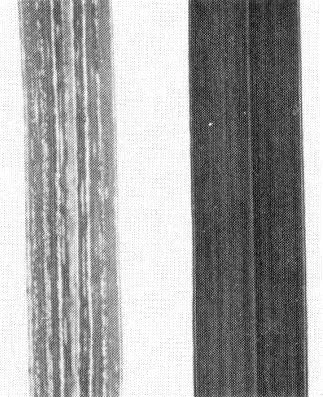
Early symptoms appear as light green or yellow streaks or dashes that run parallel to the veins of the leaves.
As the disease progresses, these symptoms manifest as a distinctive mosaic pattern that covers the entire leaf surface, eventually leading to general chlorosis.
Infected winter wheat and barley plants often exhibit stunted growth and reduced tillering, giving the crop an uneven and patchy appearance.
Heavily infected plants may show signs of leaf twisting, poor spike development, and reduced grain set, which significantly impacts yield.
In advanced stages, the infected plant tissue may develop necrotic lesions, leading to the gradual browning and death of the leaves.
Pathogen
The causal agent of this disease is the Wheat streak mosaic virus (WSMV), which is a member of the Tritimovirus genus.
This virus has elongated, filamentous particles that contain single-stranded RNA as their genetic material.
The primary vector for the transmission of the virus is the wheat curl mite, known scientifically as Aceria tosichella.
The virus cannot be transmitted mechanically through contact or via soil; it requires the mite to survive and move between plants.
WSMV is an obligate parasite, meaning it can only replicate within living host plant tissues, utilizing the host's machinery for its proliferation.
Conditions for development
The spread of WSMV is heavily dependent on the "green bridge" effect, where the virus and mites survive on volunteer wheat or grassy weeds during the off-season.
Warm and dry conditions during late summer and early autumn favor the rapid migration of the wheat curl mite from old crop remnants to newly emerged seedlings.
The mites are wind-dispersed, allowing them to travel significant distances to infect neighboring fields of winter wheat.
A mild autumn allows for a longer period of mite activity, which increases the cumulative infection rate across the field.
High temperatures during the growth stages can accelerate the development of the viral symptoms, putting additional stress on the plant.
Why it matters
Wheat streak mosaic is considered one of the most economically damaging viral diseases for winter wheat and barley production worldwide.
The disease leads to severe reductions in grain yield by reducing the number of grains per head and decreasing the individual weight of the kernels.
Plants weakened by the virus are significantly more susceptible to environmental stresses, including winter injury and moisture deficits.
The quality of the harvested grain is often poor, which lowers its market value and potential for food or feed processing.
In severe cases, fields may suffer such extensive damage that the crop fails entirely and requires tillage and replanting.
Protection
The most critical management practice is the complete removal of all volunteer wheat and grassy weeds at least two weeks before planting new crops.
Avoiding early planting dates for winter wheat helps minimize the window of exposure to mite migration during the fall.
Implementing a crop rotation system with non-host crops is an effective way to interrupt the viral cycle and reduce mite population densities.
Selecting and planting resistant or tolerant wheat varieties is the most sustainable approach to mitigating yield losses caused by the virus.
Because there are no direct chemical controls for the virus, field management must focus entirely on controlling the mite vector and its host plants.
Pathogens and affected parts
Affects crops · 2
Discussion
No discussions yet — be the first.