
Little cherry disease
Cherry little cherry closterovirus
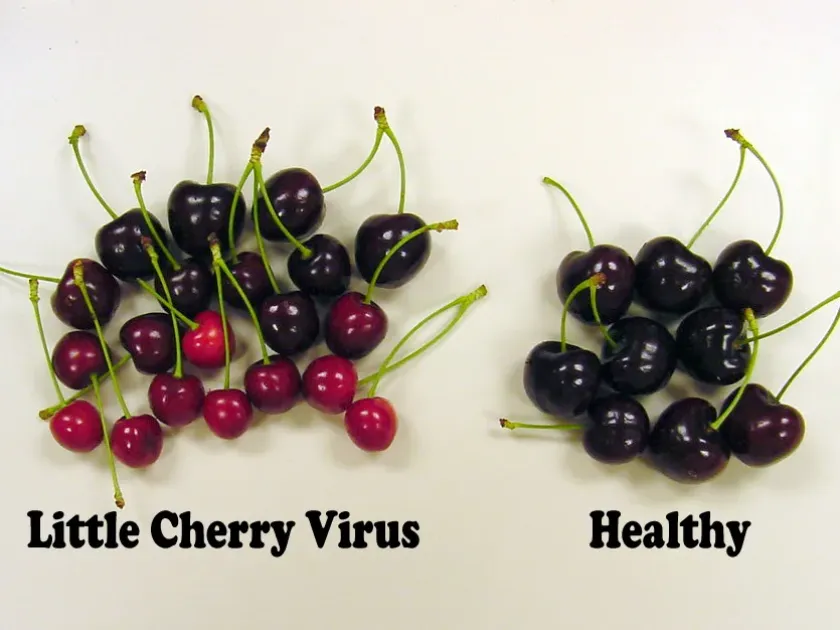
Description
Symptoms
The primary symptom of the disease is a significant reduction in fruit size, with berries becoming small, pale, and failing to develop normal flavor.
Affected cherries often fail to ripen fully, staying small and acidic, and may drop from the tree prematurely before they reach harvestable maturity.
Foliage on infected trees can sometimes show signs of abnormal coloration, such as reddening or bronzing, indicating a serious disruption of plant metabolism.
Trees may exhibit stunted growth, reduced vigor, and a bushy, rosette-like appearance of the branches, often referred to as a "witches' broom" effect in severe cases.
Overall yield declines drastically over several seasons, eventually rendering the tree unproductive and economically useless for commercial production.
Pathogen
The disease is caused by a group of viruses, most notably Little cherry virus 1 (LChV-1) and Little cherry virus 2 (LChV-2).
These viruses reside within the phloem tissues, effectively blocking the translocation of essential sugars and nutrients from the leaves to the fruit.
Once a tree is infected, the pathogen persists throughout its lifespan, as there is currently no chemical cure for these viral infections in trees.
Transmission occurs primarily through the use of infected propagation material, such as scion wood or rootstocks obtained from unreliable sources.
In the field, the disease is spread by insect vectors, including specific species of mealybugs and leafhoppers that feed on the infected sap.
Conditions for development
Disease spread is highly dependent on the population density of insect vectors, which act as the bridge between infected and healthy trees.
Environmental conditions that favor the rapid reproduction of mealybugs and leafhoppers significantly increase the risk of transmission within the orchard.
Mechanical transmission can also occur during pruning or grafting if tools are not properly sanitized between working on individual trees.
Warm climate conditions generally accelerate the systemic movement of the virus throughout the tree's vascular system, leading to faster symptom expression.
The introduction of infected nursery stock into a new orchard is the most common factor responsible for establishing new infection epicenters.
Why it matters
The economic impact is severe, as the fruit produced on infected trees is unmarketable due to its small size and poor quality.
The virus causes a slow decline in tree health, weakening the root system and making the tree more susceptible to secondary stressors and diseases.
Infected trees serve as a continuous reservoir for the virus, ensuring that nearby healthy trees are at a high risk of becoming infected over time.
Total removal and destruction of affected trees are often necessary to prevent the further spread of the virus to the rest of the plantation.
The long-term sustainability of an orchard is threatened if the disease is not managed through rigorous exclusion and monitoring practices.
Protection
The foundation of control is the use of certified, virus-free nursery stock and scion wood obtained from reliable and tested sources.
Regular monitoring of the orchard is essential for the early detection and immediate removal of any trees showing characteristic symptoms.
Vector management, involving the application of insecticides to control mealybug and leafhopper populations, is a critical preventative measure.
Strict sanitation protocols for pruning and grafting tools are required to prevent mechanical transmission during routine orchard maintenance.
- Planting certified disease-free nursery stock.
- Systematic removal of infected trees.
- Management of insect vector populations.
- Sanitation of grafting and pruning tools.
Discussion
No discussions yet — be the first.