
Ceratiomyxa fruticulosa
Ceratiomyxa fruticulosa
Description
Symptoms
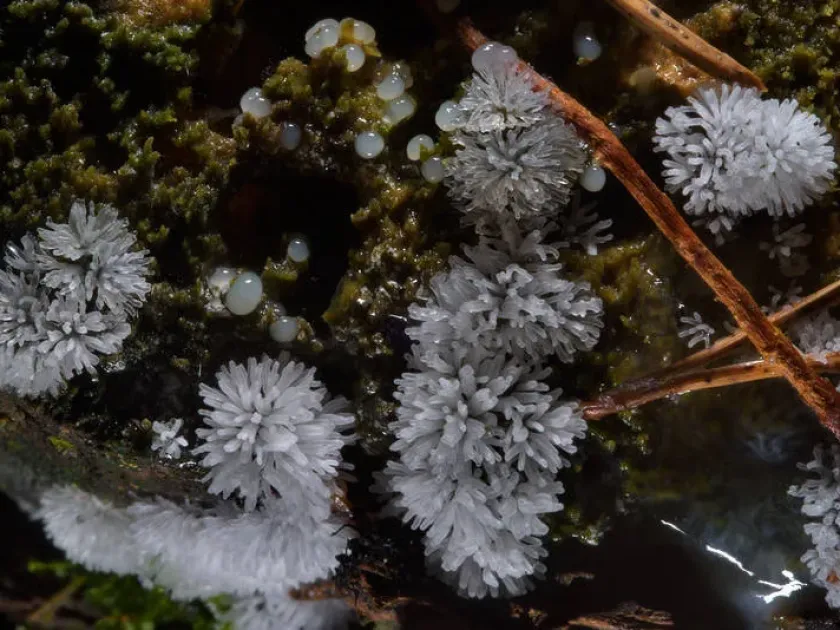
The most distinctive symptom is the appearance of white, translucent, or yellowish column-like growths that look like small corals or branched bushes on surfaces.
These fruiting bodies are often found in dense clusters, covering bark, dead wood, or wet forest floors, and can appear almost overnight under ideal conditions.
When the slime mold reaches its spore-bearing stage, the surface of these growths may appear dusty or powdery as the spores mature and prepare for dispersal.
Growths are frequently found at the base of tree trunks, on damp logs, or on moist leaf litter that is in the process of decomposition.
While often confused with fungal diseases like powdery mildew, its structural morphology as a coral-like cluster is distinct from the thin, web-like mycelia of true fungi.
Pathogen
Ceratiomyxa fruticulosa is not a true fungus but a member of the Myxomycetes group, commonly known as slime molds. These organisms exhibit both animal and fungal-like traits during their complex life cycle.
This organism functions as a saprotroph, feeding primarily on decaying organic matter, bacteria, and fungal spores. It does not actively infect or parasitize healthy living plant tissue.
The life cycle begins as a plasmodium, a mobile, jelly-like mass that crawls over surfaces. Later, it transforms into prominent, branching fruiting bodies that release spores.
Due to its microscopic spores being easily dispersed by air and water, this organism can appear rapidly in suitable environments across large agricultural or woodland areas.
In agronomy, identifying this organism is crucial because its presence is a reliable indicator of high moisture levels and poor sanitary conditions within a growing area.
Conditions for development
High relative humidity is the primary driver for the development and proliferation of Ceratiomyxa fruticulosa. It thrives in environments where moisture is constant.
Shaded, sheltered areas with limited exposure to direct sunlight provide the necessary microclimate to prevent dehydration of the delicate fruiting structures.
Temperatures ranging from 15 to 25 degrees Celsius are optimal for the rapid transition from the plasmodial phase to the formation of visible fruiting bodies.
Poor ventilation, typical in crowded garden beds or poorly managed greenhouses, allows moisture to linger on organic surfaces, encouraging colonization.
Abundant organic debris, such as mulch and decaying wood, serves as the primary food source and structural support for the organism to establish its colonies.
Why it matters
The direct damage caused by this organism to healthy plants is minimal, as it lacks the specialized structures required to penetrate living cell walls.
However, it can be problematic if it covers plant stems extensively, as this may physically obstruct gas exchange, leading to localized physiological stress.
Its presence is often a warning sign that the plant is suffering from underlying decay or that the local environment is too damp, potentially inviting other, more aggressive pathogens.
For ornamental gardens, the visual blight caused by the widespread appearance of these white, coral-like growths is often considered a significant issue.
While not a major crop killer, its unchecked presence can accelerate the decomposition of valuable mulch or wooden structures in an agricultural or residential setting.
Protection
The most effective management strategy is to practice good garden sanitation by removing rotting wood, stumps, and unnecessary damp organic debris from the vicinity of plants.
Improving air circulation through proper pruning and strategic spacing of plants helps reduce humidity levels, making the area less hospitable to slime molds.
Optimizing irrigation practices to prevent water stagnation around the roots and trunks of plants is key to stopping the development of this organism.
Mechanical removal, such as scrubbing off the fruiting bodies with a brush, followed by keeping the surface dry, is usually sufficient to eliminate local infestations.
While chemical fungicides are generally not recommended for treating slime molds, proper maintenance and drainage management are the most sustainable preventive measures.
Discussion
No discussions yet — be the first.