
Ceratiomyxa
Ceratiomyxa
Description
Symptoms
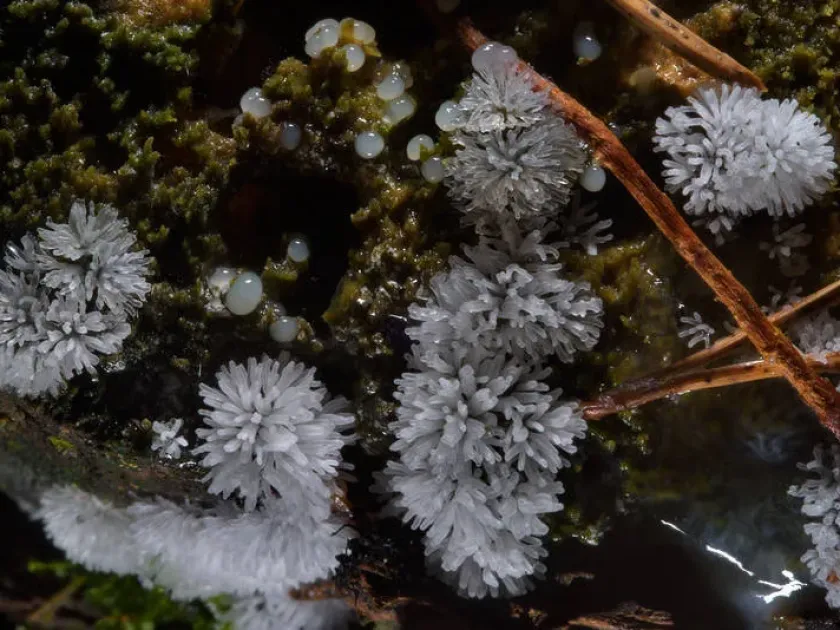
The hallmark sign of Ceratiomyxa is the emergence of white, translucent, or creamy slime-like colonies on the lower stems or the surface of leaves near the soil line.
Initially, these colonies appear as a bubbly or foamy mass that gradually develops into vertical, finger-like, or coral-like projections. These structures are soft and can be easily wiped off without causing visible damage to the plant tissue beneath.
Plants affected by the presence of these slime molds often show symptoms of waterlogging, such as yellowing leaves or stunted growth, resulting from the anaerobic soil conditions that also support the slime mold.
Unlike true pathogens, these organisms do not penetrate the plant epidermis. Therefore, no necrotic lesions or tissue rotting are typically associated directly with the slime mold itself.
Visual identification is the primary method of diagnosis, usually aided by the observation of the characteristic "fruiting bodies" which appear distinctly different from common fungal mycelium.
Pathogen
Ceratiomyxa is a genus of slime molds (myxomycetes) that belongs to the group of amoeboid protists. While often confused with fungi, they exhibit unique biological characteristics, such as the ability to move as a plasmodium.
The most commonly encountered species is Ceratiomyxa fruticulosa. In nature, it functions primarily as a saprotroph, consuming decaying organic matter, bacteria, and fungal spores in moist environments.
These organisms do not typically infect living plant tissue in the same way as pathogenic fungi or bacteria. They are rather "opportunistic" colonizers that favor surfaces of plants when environmental conditions become exceptionally damp.
The biological cycle involves a phase where they form distinct, branching, coral-like structures. These reproductive structures release spores, which are disseminated by wind or splashing water, allowing the slime mold to colonize new areas.
In agronomy, the presence of Ceratiomyxa is considered a biological marker for poor drainage, excessive irrigation, or accumulated debris, rather than a primary disease of the crop.
Conditions for development
The development of Ceratiomyxa is strictly dependent on high moisture levels. It thrives in environments where relative humidity consistently exceeds 85% and the soil surface remains saturated.
Optimal temperatures for the activity of the plasmodium phase are between 18°C and 25°C. Lower temperatures may induce a dormant stage, while extreme heat and dryness usually inhibit further growth.
Organic debris, such as leaf litter, old crop residues, or heavy mulch, serves as an essential energy source. This substrate allows the slime mold to persist and proliferate in the field.
Poor aeration in the root zone and lack of sunlight reaching the lower plant canopy create the shaded, stagnant microclimate that is perfectly suited for Ceratiomyxa expansion.
Frequent, heavy irrigation or poor field drainage that allows standing water to persist around the stem base significantly increases the risk of colonization.
Why it matters
Ceratiomyxa is generally considered a minor issue for crop production as it does not cause direct plant tissue destruction or significant yield loss through pathogenic activity.
The primary economic impact lies in the contamination of crops, especially for leafy greens or ornamental plants, where the presence of slime renders the produce unmarketable due to aesthetic issues.
Indirectly, the presence of the slime mass on leaf surfaces can physically obstruct stomata, slightly inhibiting the plant's ability to undergo gas exchange and photosynthesis.
In greenhouse settings, its presence indicates an overly humid environment that can indirectly lead to the outbreak of secondary diseases like gray mold (Botrytis) or damping-off.
While the slime itself is harmless to the plant's structural integrity, the underlying environmental factors (extreme dampness) are highly detrimental to root health and overall plant vigor.
Protection
Management of Ceratiomyxa focuses entirely on altering the microenvironment to make it unsuitable for the organism's survival, rather than applying chemical pesticides.
Improving field drainage is the most critical step. Ensuring that water can move away from the stem base is essential to preventing the conditions necessary for slime mold development.
Sanitation practices, such as clearing away decomposing crop residues and keeping the soil surface free of excess debris, are highly effective in breaking the life cycle of the slime mold.
- Adjusting irrigation schedules to allow the soil surface to dry out between waterings.
- Pruning lower leaves to improve air circulation and sunlight penetration.
- Regular hoeing to break up the soil surface and promote evaporation.
- Using mineral-based mulches instead of organic ones in high-risk areas.
Chemical control is rarely recommended because simply correcting the moisture and hygiene issues is usually enough to eliminate the problem naturally.
Discussion
No discussions yet — be the first.