
Caudovirales
Caudovirales
Description
Pathogen
Caudovirales, commonly known as tailed bacteriophages, are a vast order of viruses that exclusively infect bacteria. In agricultural science, they are not classified as plant pathogens but as vital biological agents used to suppress destructive phytopathogenic bacteria.
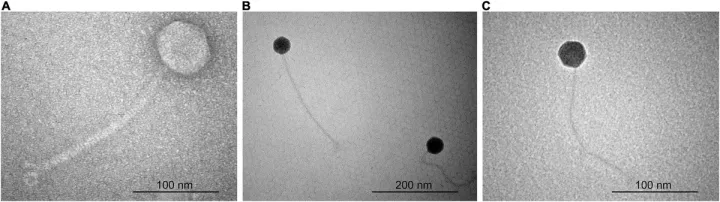
These viruses are characterized by a distinct morphology consisting of a head containing double-stranded DNA and a tail structure used for host attachment. They are divided into three families: Myoviridae, Siphoviridae, and Podoviridae, based on their tail characteristics.
The infection process starts with the phage recognizing specific proteins or polysaccharides on the surface of the bacterial cell wall. Once attached, the phage injects its genome, hijacking the bacterial machinery to produce new viral progeny.
This lytic cycle results in the lysis (bursting) of the host cell, which effectively eliminates the target bacterial population. This makes them highly efficient tools for managing outbreaks of diseases like bacterial wilt, leaf spots, and soft rots.
Unlike chemical bactericides, bacteriophages are highly specific, meaning they target only the harmful bacteria without disrupting the complex microbiome of the soil or the health of the host plant.
Conditions for development
The efficacy of Caudovirales in field conditions is highly dependent on the host density. Phage multiplication is proportional to the number of available host cells, which is why preventive application is often less effective than therapeutic application during an outbreak.
Moisture is a critical environmental requirement. Tailed phages require an aqueous medium for diffusion to reach their bacterial targets. High humidity or irrigation levels typically improve the performance of phage-based biopesticides.
Temperature significantly impacts phage stability. Exposure to direct sunlight and high temperatures can damage the viral proteins, leading to a loss of infectivity. Therefore, application is recommended during cooler times of the day, such as early morning or dusk.
The chemical composition of the environment, including pH levels and the presence of certain minerals, can affect the stability of the phage particles. Most phages perform best in near-neutral conditions, mirroring the typical environments of plant-associated bacteria.
Soil structure and organic matter content also play a role in phage dispersal. In porous soils, phages can move more freely, whereas compact or dry soils may hinder their ability to contact pathogens effectively.
Why it matters
Caudovirales are not harmful to plants, animals, or humans. Their biological structure is evolved specifically to interact with bacterial cell walls, making them one of the safest tools in integrated pest management programs.
However, from a management perspective, the potential "harm" lies in the narrow host range. If a crop is attacked by a diverse population of bacterial strains, a single-strain phage treatment may leave resistant strains unaffected, allowing them to proliferate.
Another challenge is the rapid evolution of bacterial resistance. Bacteria can undergo minor genetic mutations that alter their surface receptors, effectively preventing the phage from attaching, which forces the need for phage rotation strategies.
Furthermore, if phages are applied indiscriminately, they may negatively affect beneficial soil bacteria that contribute to nutrient cycling or plant growth promotion, potentially causing an imbalance in the rhizosphere.
In conclusion, while not pathogenic themselves, their effectiveness relies entirely on careful selection and application, as misuse can lead to ineffective disease control and the persistence of bacterial infections.
Protection
The control of bacterial diseases using Caudovirales requires an integrated approach. A key strategy is the use of 'phage cocktails'—mixtures of different phage types—to cover a broader spectrum of bacterial serotypes and minimize the risk of resistance.
Good agricultural practices are essential to support phage-based interventions. This includes reducing the initial bacterial load through proper crop rotation, sanitation, and the use of resistant plant cultivars to manage the overall disease pressure.
Storage and handling of phage preparations are crucial for success. These products are biological entities and must be stored in cool, dark environments to maintain their lytic activity until the moment of application.
Prophylactic treatments during the most vulnerable stages of plant development (such as seedling emergence or post-pruning) are recommended to establish a protective "bio-shield" on plant surfaces against colonization by pathogens.
Regular diagnostic monitoring allows growers to adjust their phage applications based on the actual pathogen strains present in the field, ensuring that the biological control program remains adaptive and highly effective throughout the growing season.
Discussion
No discussions yet — be the first.