
Beet phloem necrosis virus
Carlavirus betaphlocis
Description
Symptoms
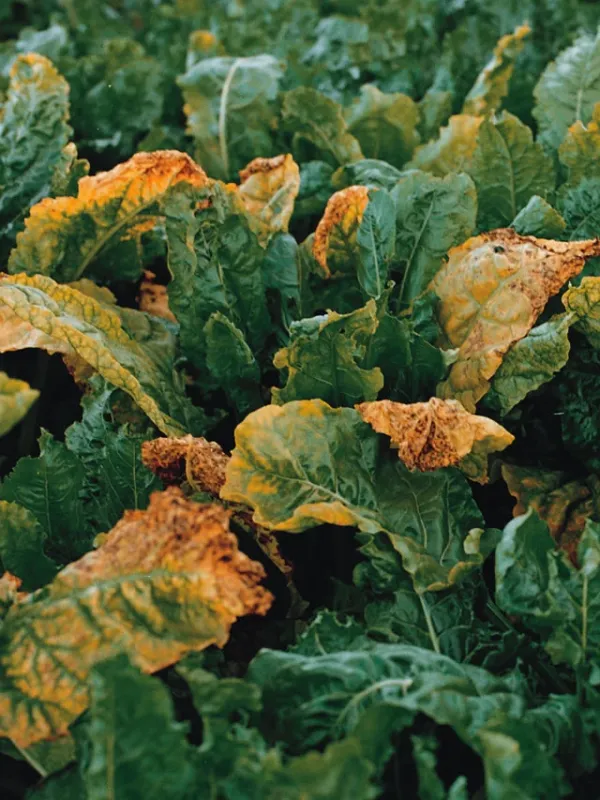
Early symptoms of beet phloem necrosis often include leaf yellowing and mosaic patterns. As the disease progresses, the leaves may show signs of curling, deformation, and premature wilting.
The infection manifests as severe stunting of the plant. Infected sugar beets appear significantly smaller and less vigorous compared to healthy plants in the same field.
A diagnostic internal symptom is the browning or necrosis of the vascular bundles within the taproot. This damage effectively prevents the root from developing properly.
In the field, the disease usually appears in patches, corresponding to the initial sites where winged aphids landed and established colonies.
- Yellowing and mosaic patterns on leaves.
- Leaf curling, distortion, and stunted growth.
- Browning and necrosis of the taproot vascular rings.
- Significant reduction in plant biomass.
- Premature leaf senescence and death.
Pathogen
The beet phloem necrosis virus belongs to the Carlavirus genus. This phytopathogen specifically attacks the plant's vascular tissue, primarily the phloem, effectively disrupting the translocation of essential nutrients from leaves to the taproot.
The virus particles have a filamentous structure typical of the Carlavirus genus. It is highly specialized, meaning it targets specific hosts, making it a persistent challenge in commercial sugar beet cultivation.
The primary vectors for this virus are various species of aphids. These insects acquire the virus by feeding on infected plants and subsequently transmit it to healthy ones during their feeding cycles.
The virus is capable of overwintering in perennial weed hosts and crop residues, which serves as a constant reservoir for new infections each growing season.
Understanding the biology of this pathogen is crucial, as its spread is intrinsically linked to the migration patterns and population dynamics of its aphid vectors.
Conditions for development
The development of beet phloem necrosis is favored by warm and moderately humid weather, which accelerates the reproductive rate of aphid populations.
High weed density near field borders provides a sanctuary for both the virus and its vectors, allowing for quick re-infestation of the sugar beet crop.
Insufficient crop rotation cycles, where sugar beets are planted too frequently on the same land, contribute to an increase in the local viral infection load.
Early-season aphid colonization is the most critical period. If environmental conditions promote early migration, the entire field can become infected before control measures are implemented.
Mild winter temperatures often lead to higher survival rates of aphid populations, which can trigger an earlier and more aggressive outbreak during the following spring.
Why it matters
The primary economic impact is a drastic reduction in total root yield. Because the phloem is damaged, the plant fails to transport adequate photosynthates to the storage root.
Beyond weight loss, the quality of the sugar beet is severely compromised. Infected roots show decreased sugar content and higher levels of impurities, complicating industrial processing.
The virus predisposes the weakened plants to secondary infections, such as root rot and fungal pathogens, leading to massive post-harvest losses during storage in clamps.
Farmers face financial strain due to the combination of reduced yields and the high cost of intensive insecticide applications required to keep vector populations in check.
Severe outbreaks can render a sugar beet field economically non-viable, forcing growers to prioritize rigorous preventative strategies over reactive treatments.
Protection
Effective management focuses primarily on the control of aphid vectors. The use of systemic insecticides during critical migration periods is essential to prevent virus transmission.
Strict weed management in and around the fields is mandatory to remove alternative hosts that harbor the virus during the off-season.
Spatial isolation of new sugar beet fields from previous years' planting sites is a fundamental practice to minimize the risk of early colonization by infected aphids.
The use of certified, disease-free seed and selecting resistant or tolerant hybrid varieties can provide a solid foundation for managing the risk of infection.
Monitoring aphid activity using yellow sticky traps is a recommended practice, allowing growers to time their insecticide applications for maximum efficacy.
Discussion
No discussions yet — be the first.