
Caloneis
Caloneis
Description
Symptoms
Massive growth of Caloneis typically manifests as a greenish-brown or yellowish slimy layer on the soil surface, especially after irrigation or rain.
When the soil dries out, this algal biomass can form a fragile, brittle crust that may crack into small polygons on the surface.
Visible signs often appear in low-lying areas of a field or in greenhouses where soil moisture remains consistently high and light exposure is sufficient.
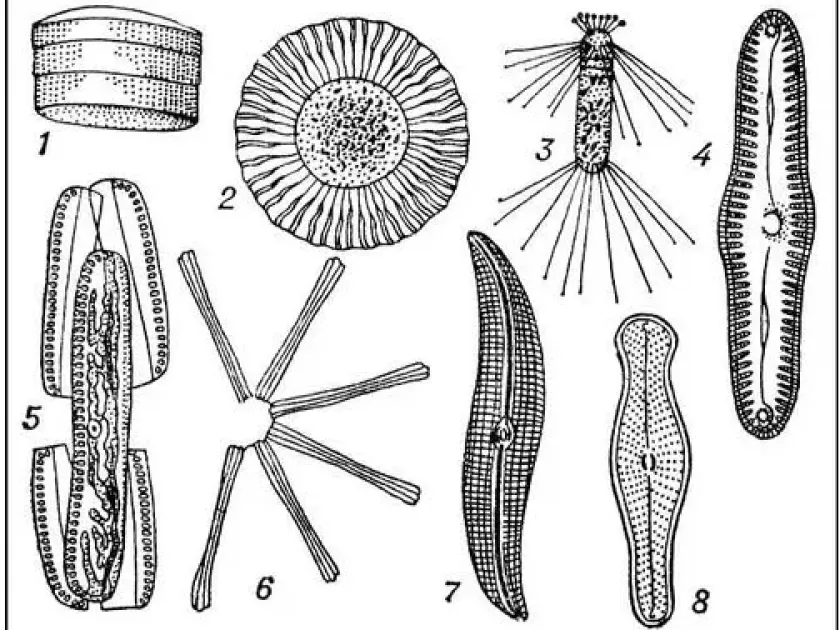
Under microscopic analysis, Caloneis cells exhibit a distinct elongated, symmetrical shape with a clearly visible raphe system characteristic of the genus.
It is important to differentiate these algal crusts from fungal mats or slime molds, as the former are strictly linked to light-exposed surfaces.
Pathogen
Caloneis is a genus of diatom algae that resides in soil, freshwater, and brackish environments. It is not a plant pathogen and does not cause diseases in crops.
In agronomy, Caloneis is recognized as a part of the soil algae community, which performs photosynthesis and contributes to the soil's organic matter.
These organisms are characterized by their silica cell walls, which provide structural stability and contribute to the silica cycle within the soil ecosystem.
As photoautotrophs, they rely on light energy to synthesize their organic compounds and are typically found in the uppermost surface layers of the soil.
The study of Caloneis in agricultural fields is primarily focused on their function as biological indicators of soil moisture and surface conditions.
Conditions for development
The primary driver for the proliferation of Caloneis is excessive soil moisture, particularly in poorly drained agricultural fields or during over-irrigation.
Sunlight is a necessary condition for their survival and reproduction; therefore, they are most active in open, non-shaded areas of the soil.
These diatoms are highly adaptable to various temperate conditions and can thrive in different soil types, provided that humidity and light availability are met.
The presence of available silica in the soil solution supports the development of their protective shells, enhancing their competitive success in specific microhabitats.
Increased soil compaction and a lack of soil aeration can create a stable environment that favors the accumulation of algal populations.
Why it matters
While Caloneis is not a plant parasite, dense surface crusts caused by algal blooms can physically hinder seedling emergence and germination.
These crusts reduce the rate of gaseous exchange between the atmosphere and the soil, potentially affecting the oxygen supply to the plant roots.
Persistent algal growth may indicate drainage problems or improper water management, leading to waterlogged soil conditions detrimental to sensitive crops.
The accumulation of dead biomass from algae can alter the nutrient availability and microbial dynamics in the surface soil horizon temporarily.
Economic damage is typically minimal, but it can complicate seedbed preparation and early-season field maintenance in heavy, moisture-retaining soils.
Protection
Improving field drainage is the most effective way to prevent excessive growth of Caloneis, as it removes the primary trigger—soil saturation.
Regular cultivation and harrowing of the soil surface help break up algal crusts, enhancing aeration and interrupting the light availability needed by algae.
Optimizing irrigation schedules ensures that the soil surface does not remain constantly wet, which naturally suppresses the formation of diatom mats.
Maintaining good soil structure through organic matter integration helps improve water percolation, thereby discouraging the development of water-dependent organisms.
Chemical control with algicides is generally unnecessary and rarely practiced in large-scale agriculture, as it may disrupt the beneficial soil microbiome.
Discussion
No discussions yet — be the first.