
Bunyaviruses
Bunyavirales
Description
Symptoms
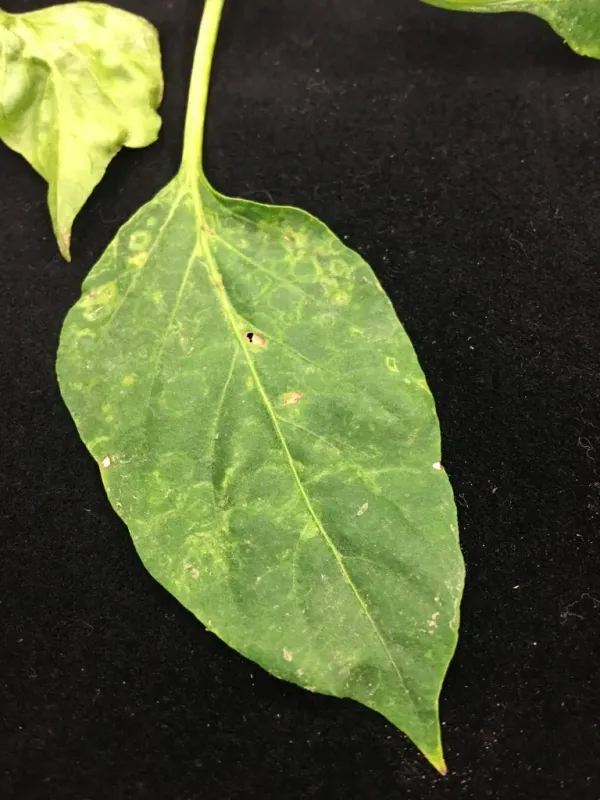
The clinical presentation of a bunyavirus infection is highly variable depending on the host and environmental conditions. Common symptoms include chlorotic spots, mosaic patterns, and ring-like necrosis on leaves.
Plant growth is frequently stunted, with shortened internodes and deformed foliage. In severe cases, the terminal shoots may wilt and turn necrotic, leading to the eventual death of the plant.
Fruits and tubers often exhibit irregular spotting, rings, and bumpy surface deformations. These aesthetic damages render the harvest commercially worthless, even if the plant survives.
Young plants infected during early growth stages rarely recover and usually fail to develop into productive individuals. Late-stage infections lead to significant yield reduction and poor-quality produce.
- Concentric rings or spots on leaves
- Veinal necrosis and leaf distortion
- Stunting and inhibited apical dominance
- Fruit mottling and deformation
- Systemic wilting despite adequate irrigation
Pathogen
Bunyaviruses, specifically those belonging to the order Bunyavirales and family Tospoviridae, are significant plant pathogens characterized by a segmented, single-stranded RNA genome. These viruses rely on specialized insect vectors for transmission.
The most economically damaging representative is the Tomato spotted wilt virus (TSWV). It has a remarkably wide host range, affecting hundreds of plant species including vegetables, ornamentals, and various legumes.
The virus particle is spherical and enveloped, which makes it somewhat susceptible to environmental factors but highly efficient at hijacking the host cell's machinery for systemic infection once introduced.
Due to the segmented nature of their genome, these viruses are prone to reassortment, which can lead to the rapid emergence of new, more aggressive viral variants that challenge traditional crop resistance.
Molecular diagnostics, such as ELISA and RT-PCR, are standard tools for identifying these pathogens, as they often present with symptoms that are easily confused with abiotic stress or nutrient deficiencies.
Conditions for development
The primary factor facilitating the spread of these viruses is the presence of thrips, particularly the Western flower thrips (Frankliniella occidentalis). The virus is acquired by larvae and transmitted by adult insects.
High temperatures and humidity, particularly within greenhouse environments, accelerate the life cycle of the vectors, leading to explosive population growth and rapid viral dispersal throughout the facility.
Weed hosts, such as common garden weeds, serve as essential reservoirs for the virus, allowing it to persist throughout the year and provide a source of inoculum for subsequent crop plantings.
Transmission can also occur via contaminated propagation material, such as cuttings or nursery transplants, which may appear asymptomatic but harbor the virus in their vascular tissues.
While mechanical transmission by handling or tools is less frequent compared to vector-mediated transmission, it remains a possible secondary pathway for localized spread in dense greenhouse settings.
Why it matters
Bunyaviruses pose a severe threat to global agriculture because there are no curative treatments available for infected crops. Once a plant is systemically infected, it serves as a source of inoculum for others.
The economic impact involves both substantial yield losses and the high cost of intensive vector management programs. In many cases, entire crops must be destroyed to prevent a large-scale epidemic.
Plants weakened by the virus become highly susceptible to secondary infections, including fungal pathogens and bacterial soft rots, which further complicate the health status of the field.
International trade is significantly impacted by these viruses, as strict phytosanitary regulations are enforced to prevent the cross-border movement of infected plant materials and specific thrips species.
The persistent nature of the virus in vector populations requires farmers to engage in year-round monitoring and aggressive control, significantly increasing the overhead costs of production.
Protection
The core of bunyavirus management is the strict control of thrips populations. Integrated Pest Management (IPM) strategies, including the use of biological control agents and targeted insecticides, are essential.
Eliminating weed reservoirs in and around production sites is a critical sanitation practice that limits the virus's ability to survive between crop cycles.
Using virus-indexed, certified disease-free propagation material is the most effective preventative measure. Growers should enforce strict quarantine protocols for all new plant introductions.
Breeding for genetic resistance remains the long-term solution. Researchers are constantly working to identify and incorporate resistance genes into commercial cultivars to provide a sustainable defense.
Physical barriers such as fine-mesh insect screens on greenhouse vents, combined with the use of blue and yellow sticky traps for monitoring, help significantly reduce the influx of vectors into the crop canopy.
Discussion
No discussions yet — be the first.