
Description
Symptoms
Symptoms typically appear during the reproductive stages of soybean development. Foliar symptoms include interveinal chlorosis and necrosis, with the leaf tissue between the veins turning yellow while the veins remain green.
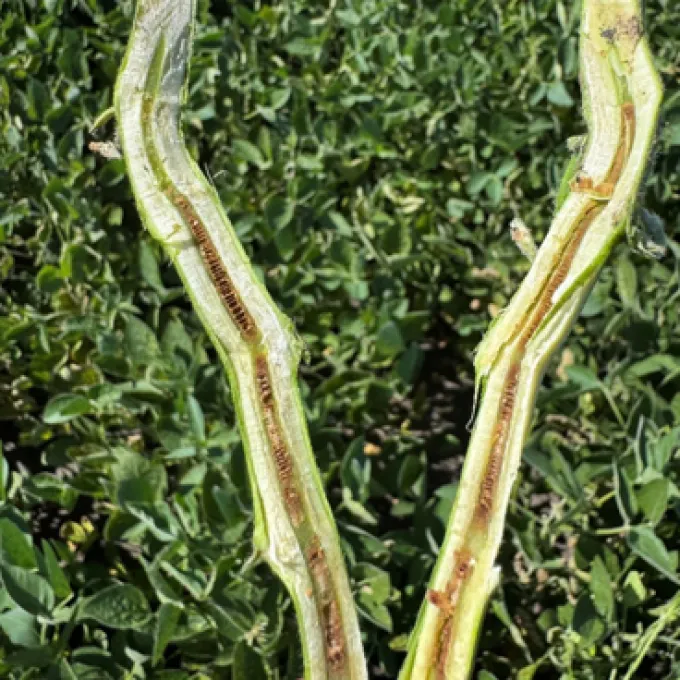
The most diagnostic feature of the disease is the internal browning of the stem pith. When a stem is split longitudinally, the pith tissue displays a distinct dark brown discoloration, starting from the base and moving upwards.
External stem appearance may seem healthy at first, which often leads to late detection. However, as the disease progresses, the plants may wilt and lodge, especially under moisture stress conditions.
Affected plants often die prematurely. The leaves may stay attached to the stem while the plant withers, which creates a specific visual pattern in the field compared to other types of wilting.
Root systems generally do not show severe decay, which is a critical diagnostic observation for agronomists distinguishing brown stem rot from other root-rotting fungi like Phytophthora or Pythium.
Pathogen
The causal agent of brown stem rot in soybean is the fungus Cadophora gregata (formerly known as Phialophora gregata). This pathogen infects the xylem tissue, causing a systematic infection that hinders water and nutrient transport.
The fungus survives in infested crop residues and soil for several years. It can also be transmitted via infected seeds, allowing the pathogen to spread to previously healthy areas over time.
Inside the host plant, the fungus produces mycelium that colonizes the vascular system. This process results in the production of fungal toxins that lead to the characteristic internal browning observed in stems.
There are different strains of the pathogen, which vary in their ability to cause severe symptoms. Some strains are more aggressive and cause rapid wilting, while others lead to more localized damage.
The pathogen thrives during the growing season, particularly when soil moisture and temperature are optimal. Understanding the life cycle of Cadophora gregata is essential for implementing effective scouting and control strategies.
Conditions for development
Cool and moist conditions during the early stages of soybean growth favor infection. The fungus is most active when soil temperatures are in the 15°C to 25°C range during vegetative development.
Long-term monoculture or intensive soybean cropping systems significantly increase the inoculum levels in the soil. Frequent planting of susceptible varieties builds up the population of Cadophora gregata.
High soil moisture during the summer can accelerate the development of symptoms within the stem. Environmental stress factors, including soil compaction or nutrient imbalances, can further weaken plants, making them easier targets.
Reduced tillage practices can sometimes contribute to higher disease pressure, as they leave infected crop residues on the soil surface, providing a continuous source of inoculum for subsequent seasons.
Field history is a key predictor of disease. Areas with a documented record of brown stem rot are at a high risk of recurring infections if management practices are not adjusted accordingly.
Why it matters
Brown stem rot causes substantial yield losses, sometimes reaching up to 50% in highly susceptible fields. The losses occur due to reduced seed filling and premature plant death before maturity.
The disease negatively impacts grain quality by reducing seed size and weight. This leads to lower market value and potential issues with grain processing and nutritional content.
Lodging of affected plants causes harvesting difficulties, leading to increased field losses during combine operation. This adds to the overall economic impact on the farm business.
The spread of the pathogen through seed movement poses a long-term risk to regional production. Once a field is infested, the disease management becomes a permanent part of the farm's agronomic planning.
In addition to yield, the disease reduces the crop's competitiveness, as weakened plants are more susceptible to secondary pathogens and pests, further complicating the field management.
Protection
The primary control strategy for brown stem rot is the use of resistant soybean cultivars. Breeding programs have identified genetic resistance traits that are highly effective in minimizing yield losses.
Crop rotation is essential for managing soil-borne inoculum. A rotation interval of at least 3 years with non-host crops like corn or small grains is recommended to decrease the fungus's survival.
Tillage management aimed at burying or accelerating the decay of soybean stubble can reduce the amount of inoculum available. This helps to break the cycle of infection in the field.
Seed treatments are often used to protect young plants from early-season infection. While they may not provide full control, they can improve stand establishment and early growth vigor.
- Monitor fields regularly during the R3-R5 growth stages for symptoms.
- Optimize soil fertility to ensure plants have adequate potassium and phosphorus.
- Avoid overly dense planting that maintains high humidity in the canopy.
Pathogens and affected parts
Affects crops · 1
Discussion
No discussions yet — be the first.