
Beet purple leaf virus
Betapartitivirus purpurae
Description
Symptoms
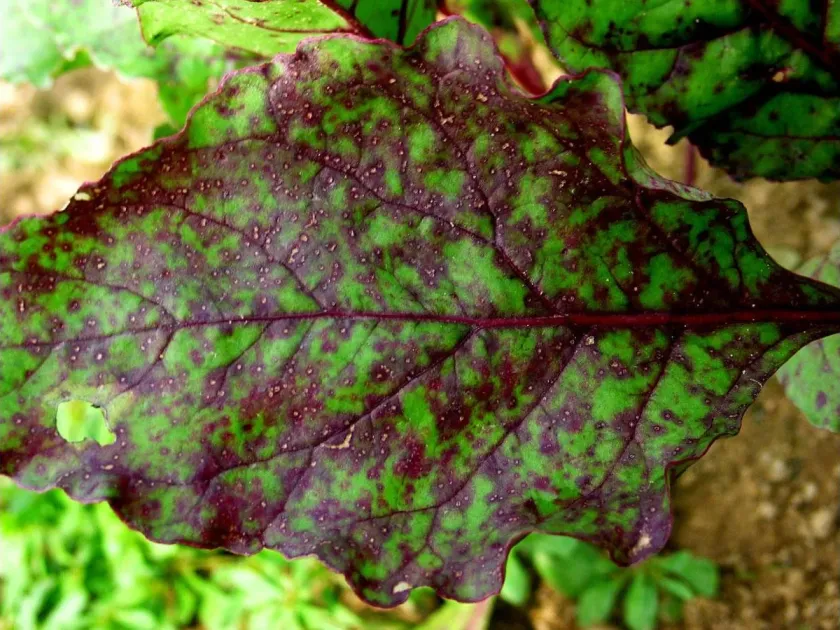
The primary external manifestation of this disease is a specific color change in the leaf blade. Leaves of an infected plant turn a distinct purple or dark red hue, starting from the edges and gradually spreading towards the center.
In addition to color changes, deformation of the leaf blades is observed. The leaves become denser and leathery to the touch, and their edges may curl downwards, giving the plant a characteristic stunted appearance.
In advanced cases, the growth of the root crop is slowed down, leading to significant developmental lag compared to healthy specimens in the field. The overall biomass of the plant is significantly reduced.
In the early stages, symptoms may be subtle and masked by nutritional deficiencies, such as phosphorus starvation. However, the systemic nature of the infection covering all leaves in the rosette is the main diagnostic sign of the virus.
When examining the root in cross-section, vascular changes are sometimes recorded, although they are less specific than leaf symptoms. The disease often manifests in patches, affecting groups of neighboring plants.
Pathogen
The causative agent is Betapartitivirus purpurae, which belongs to a group of viruses with a segmented double-stranded RNA genome. This viral disease primarily affects sugar beet crops.
The virus is naturally transmitted by insect vectors, most commonly aphids, which feed on the sap of infected plants. Viral particles enter the insect's salivary glands and are transmitted to healthy plants during feeding.
The incubation period of the virus depends on the activity of the vectors and weather conditions. Once inside the plant tissue, the virus begins active replication in cells, disrupting normal metabolism and chlorophyll synthesis.
Beet purple leaf virus is a systemic pathogen, meaning it spreads throughout the plant's vascular system via the phloem. This makes local treatment of individual leaves impossible.
The biology of the pathogen is closely linked to the lifecycle of its vectors. Without insect vectors, the spread of the virus within a field or between neighboring crops effectively stops.
Conditions for development
Disease development is most intense during periods of mass aphid reproduction. Dry and warm weather promotes active insect migration, which directly increases the rate of virus spread.
Soil moisture also plays a role: stress conditions, such as short-term droughts, make plants more vulnerable to viral infections. Plants weakened by adverse factors are infected more quickly.
Infected weeds growing along field edges or in close proximity often act as infection reservoirs. The virus can persist in them throughout the winter and spread to beet seedlings in the spring.
Agrotechnical sowing dates affect the degree of infection. Crops in their active growth phase during the peak activity of vectors have a higher chance of mass infection.
Poor crop rotation and leaving beet culls in the field contribute to virus accumulation in the soil and root zone, creating a favorable background for early infection of young seedlings.
Why it matters
The harmfulness of the virus is primarily expressed in a significant reduction in crop productivity. Infected plants accumulate significantly less sugar in their roots, leading to a decrease in yield output.
Root weight in infected plants can decrease by 20–40% depending on the timing of infection. Early infection leads to more catastrophic consequences for the harvest.
In addition to quantitative losses, a deterioration in raw material quality is observed. Increased impurity levels and disrupted sugar content complicate the processing process at sugar refineries.
Infected plants become more susceptible to secondary fungal and bacterial infections. The purple leaf condition often opens the way for root rots during storage.
Economic damage is not only due to crop loss but also to costs associated with additional protective measures. Affected field areas reduce the overall profitability of crop cultivation.
Protection
The primary protection method is controlling the population of insect vectors. Timely application of systemic insecticides allows for a significant reduction in virus spread.
It is necessary to strictly maintain spatial isolation between beet crops and fields that may harbor infection reservoirs. Removing weeds around field borders is a mandatory preventive step.
Using resistant or tolerant sugar beet hybrids is the most effective long-term solution. Breeding programs are actively working on increasing resistance to viral pathogens.
Adhering to crop rotation helps break the virus spread cycle. It is not recommended to plant beets in the same field more often than every 3–4 years to avoid vector accumulation and viral load.
It is important to monitor the condition of the crops from the moment of emergence. Early detection of disease outbreaks allows for localized infection management and prevents its epiphytotic spread across the entire area.
Discussion
No discussions yet — be the first.