
Tobacco necrosis virus
Betanecrovirus nicotianae
Description
Symptoms
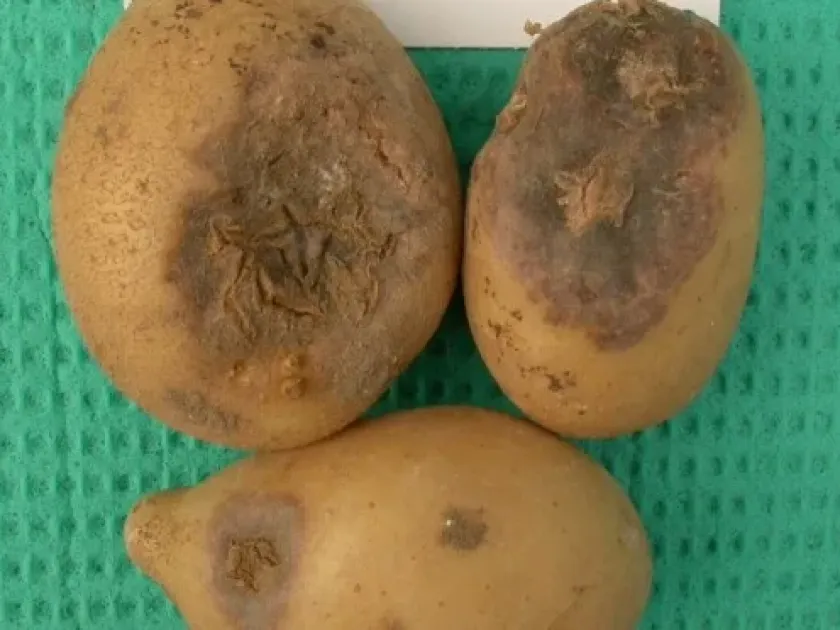
The most characteristic symptom is the appearance of necrotic spots on leaves, stems, and roots. These spots are often dark and may develop concentric patterns as the disease progresses.
In the early stages, symptoms include yellowing and chlorosis of the leaf blades. As the infection takes hold, tissues die, leading to premature leaf drop and stunted growth of the plant.
Root systems are frequently severely affected, showing browning and necrosis. This internal decay compromises the plant's ability to absorb water and nutrients, causing general wilting.
In ornamental plants like tulips, TNV causes a disease known as "Augusta disease." It leads to twisted flower stalks, stunted growth, and the development of necrotic streaks on the petals.
In systemic cases, particularly in tomatoes, the apical meristem is suppressed. Leaves become smaller, curled, and covered in a network of necrotic lesions, severely impacting development.
Pathogen
The causal agent is the Tobacco necrosis virus (TNV), a member of the Betanecrovirus genus. It is a single-stranded RNA virus known for its extremely broad host range among both monocots and dicots.
The virus particles are small, isometric, and lack the ability to move actively. To survive and travel through the environment, the virus relies on a symbiotic relationship with specific soil microorganisms.
A critical biological aspect of TNV is its obligate association with the soil-borne fungus Olpidium brassicae. This fungus serves as a natural vector, transporting the virus into plant roots during the infection process.
TNV hosts include a wide variety of agricultural crops such as tobacco, tomatoes, cucumbers, potatoes, and beans, as well as many ornamental species like tulips and lilies.
Infection typically begins at the root level, but the virus can move systematically through the vascular system, leading to widespread tissue damage throughout the host plant.
Conditions for development
The disease spread is heavily dependent on the presence of the Olpidium brassicae fungus in the soil. High soil moisture is the primary driver for the activity of this vector.
Poor drainage and stagnant water in greenhouses create the perfect environment for the zoospores of the fungus to move through the soil, facilitating the rapid spread of the virus.
TNV is highly stable and can survive for long periods in soil, dried root debris, and organic matter. This persistence ensures that once a site is infested, the risk remains for several growing seasons.
Soil temperatures between 15°C and 20°C are optimal for the fungus, which correlates with the periods of highest infection risk for susceptible crop seedlings.
Close plant spacing significantly increases the speed of disease transmission, as the interconnected root systems allow the fungal vector to move easily from plant to plant.
Why it matters
The economic impact of TNV is substantial, primarily due to the loss of crop yield and reduced marketability of infected products. Plants often fail to reach maturity or produce usable yields.
In vegetable production, the virus causes a sharp decline in plant productivity. Fruits from infected plants are often deformed, small, and unmarketable, leading to direct financial losses.
The ornamental industry suffers major losses from "Augusta disease," where entire batches of bulbous flowers must be destroyed, as they lose all commercial value due to necrotic deformities.
The reduction in photosynthetic capacity caused by necrotic leaf lesions weakens the plant's immune system, making it much more susceptible to secondary bacterial and fungal infections.
Severe early-season infections can kill young seedlings entirely, causing gaps in the field that require replanting and increase labor costs for the grower.
Protection
The primary prevention strategy is the use of healthy, certified propagation material. Never introduce seedlings that show any signs of root or leaf necrosis into a clean production area.
Sterilizing the soil or growing media is highly effective. Methods such as steam sterilization or the use of chemical fumigants can eliminate the Olpidium brassicae vector entirely.
Managing soil moisture is essential. Improving greenhouse drainage and avoiding over-irrigation are key steps to limiting the movement of the fungal vector.
Rigorous sanitation of all tools, greenhouse surfaces, and containers is vital to prevent mechanical transmission. All equipment should be regularly disinfected with appropriate agents.
- Promptly remove and destroy all infected plants and their root zones.
- Implement strict crop rotation schemes, avoiding susceptible crops in infested fields.
- Control weeds around the production area, as they can act as asymptomatic virus reservoirs.
Discussion
No discussions yet — be the first.