
Solanaceous yellowing begomovirus
Begomovirus solanumflavusvietnamense
Description
Symptoms
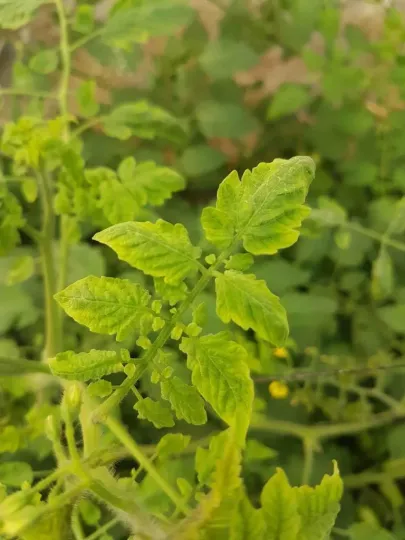
The primary symptom of this infection is intense interveinal yellowing, which eventually progresses into chlorosis across the entire leaf blade. In young plants, there is significant growth stunting and distortion of apical leaves, which severely hampers the overall development of the bush.
Leaves often curl upward at the edges, forming a characteristic cup-like shape, leading to a substantial loss of photosynthetic surface area. Mosaic patterns become more pronounced as the disease progresses, with alternating yellow and light green patches across the foliage.
Severe infection often leads to massive dropping of flowers and fruit sets, rendering crop production economically unviable. Fruits that manage to develop are usually deformed, smaller in size, and suffer from uneven maturation and coloration.
Symptomatology can vary significantly depending on the growth stage at which the plant was infected. Typically, the disease starts in the upper foliage tiers and gradually spreads downward throughout the plant.
Agronomists should note that viral yellowing is distinct from nutrient deficiency-related chlorosis due to the structural changes in leaf tissue, which are typical of systemic viral infections.
Pathogen
The pathogen is a virus from the Begomovirus genus, belonging to the Geminiviridae family, characterized by a single-stranded circular DNA genome. These viruses are notorious for their high mutation rates, which pose significant challenges for breeding resistant cultivars.
The primary vector for the infection is the tobacco whitefly, Bemisia tabaci, which transmits the virus in a persistent, circulative manner. The insect acquires the virus after a brief feeding period on an infected plant and remains a vector for the rest of its life.
Viral particles localize within the plant's phloem, interfering with the transport of sugars and other essential nutrients. This causes a disruption of physiological processes and reduces the plant's systemic immune response.
Reservoirs for the virus include not only cultivated solanaceous crops but also numerous weed species growing near greenhouses or in open fields. While mechanical transmission through handling exists, it is significantly less frequent than vector-based transmission.
The flexible genome of begomoviruses allows them to adapt rapidly to new environments, evolving to overcome plant defense mechanisms and establishing themselves in new geographical regions.
Conditions for development
High air temperatures and relatively low humidity create ideal conditions for disease outbreaks, as these factors stimulate the activity and reproduction of whiteflies. The peak incidence usually occurs during warm spring months and throughout the summer.
Plant density plays a key role in pathogen spread, as crowded conditions facilitate the movement of insect vectors between adjacent rows. Failure to maintain strict sanitation in greenhouses creates ideal conditions for continuous infection cycles.
Weedy vegetation around greenhouse complexes acts as a green bridge for the survival of both the virus and whiteflies during off-seasons. Weed control is therefore a critical component of any integrated pest management program.
Temperatures exceeding 25°C accelerate the whitefly life cycle, leading to a rapid increase in population density per unit area. Higher pest pressure directly correlates with a higher probability of every individual plant becoming infected.
The greenhouse microclimate typically provides a favorable environment for constant pest feeding on tender solanaceous tissues, ensuring a stable and persistent threat throughout the growing cycle.
Why it matters
The main threat is a significant loss of yield, which in some cases can reach total crop failure. Infected plants lag significantly in growth, becoming stunted and losing their ability to produce marketable fruits.
Infection at early phenological stages is the most critical, as it can completely stop the development of the entire crop. This creates major risks for commercial farms specializing in early vegetable production.
Economic losses also include high costs associated with aggressive whitefly control using chemical insecticides, which often complicates compliance with food safety standards. Infected fields become permanent sources of threat to neighboring plots.
Viral infection weakens the plant's metabolism, making it more susceptible to secondary bacterial and fungal pathogens. This results in the development of complex disease scenarios that further degrade crop health.
The decline in marketable quality often makes produce unsuitable for sale in retail chains, leading to both reputational damage and direct financial losses for agricultural enterprises.
Protection
The primary control measure is the constant monitoring of whitefly populations using yellow sticky traps. Early detection and prompt initiation of insecticide treatments are essential to slow down the virus spread within the greenhouse.
It is crucial to maintain spatial isolation and eliminate weeds that serve as disease reservoirs. Clearing plant debris immediately after harvest is a mandatory part of any sanitation program.
Installing fine-mesh screens on ventilation openings and doorways minimizes the entry of insect vectors from the outside. Ensuring the structure is well-sealed before the start of the season is critical for prevention.
Chemical control must be based on a rotation of active ingredients to prevent the development of resistance in whitefly populations. All interventions should be integrated and aimed at reducing pest pressure at the earliest possible stage.
Selecting resistant or tolerant hybrids of tomatoes and other solanaceous crops is the most effective long-term strategy for minimizing losses. Biological control methods, such as the use of predatory insects and parasitoids, provide a valuable supplement to integrated pest management systems.
Discussion
No discussions yet — be the first.