
Tomato yellow leaf curl virus
Begomovirus solanumflavuskanchanaburiense
Description
Symptoms
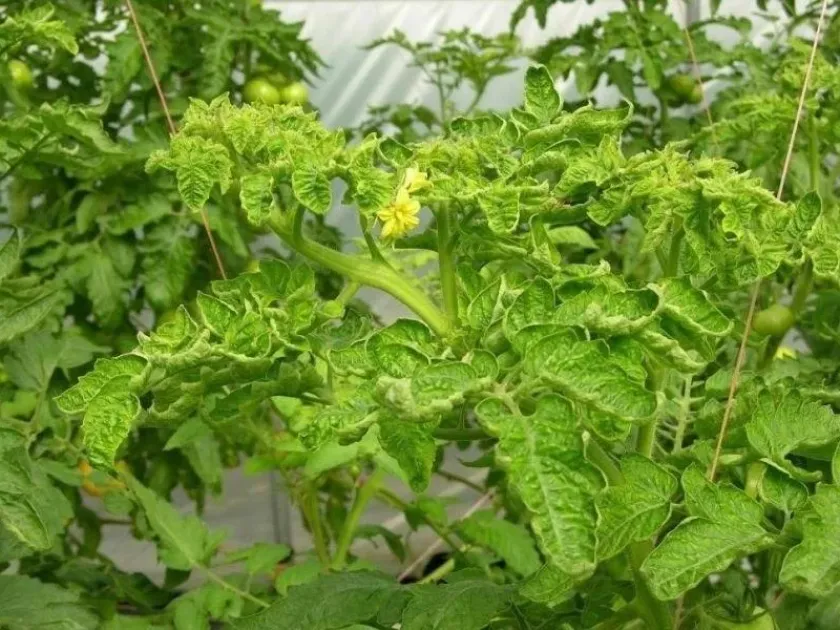
The primary symptom of infection is severe leaf curling and crinkling, accompanied by stunted development. Leaves often exhibit upward curling and a significant reduction in total surface area.
A characteristic sign of the disease is intense yellowing (chlorosis) of the leaf margins and interveinal areas. The main veins often retain their green color, creating a sharp contrast against the yellowed tissue.
Infected plants display a distinct bush-like appearance due to shortened internodes and prolific lateral branching. Growth is severely inhibited, resulting in a stunted plant that fails to reach maturity.
Flowering is usually suppressed, and if flowers do form, they often abscise before fruit set. Any fruit that develops is typically small, misshapen, and commercially valueless, leading to significant yield reduction.
Symptoms are most pronounced when plants are infected at the seedling stage. Early exposure to the virus often results in the complete failure of the plant to produce a viable harvest.
Pathogen
The disease is caused by Begomovirus solanumflavuskanchanaburiense, a member of the Geminiviridae family. It is characterized by a small, single-stranded circular DNA genome.
This virus is a significant pathogen of solanaceous crops worldwide. It is exclusively transmitted by the whitefly Bemisia tabaci, which serves as the primary vector for the virus in field conditions.
Transmission occurs through a persistent circulative mechanism. Once a whitefly ingests the virus by feeding on an infected plant, the virus moves through the insect's gut and hemolymph to the salivary glands.
After a latent period, the whitefly becomes infectious and remains capable of transmitting the virus for the remainder of its lifespan. This vector-mediated transmission makes the virus highly efficient in spreading.
Due to the virus's ability to mutate rapidly, it poses a persistent threat to agricultural productivity. It cannot be transmitted mechanically through pruning tools or physical contact between plants.
Conditions for development
The epidemiology of the disease is highly dependent on the population density of the whitefly vector. High temperatures and arid conditions create the ideal environment for whitefly proliferation.
Warmer temperatures shorten the lifecycle of Bemisia tabaci, leading to rapid population explosions. Increased insect activity correlates directly with higher rates of viral transmission between plants.
Reservoir hosts, particularly common solanaceous weeds, play a critical role in the virus's survival. During off-seasons, the virus survives in these weeds, ready to infect new crops as soon as they are planted.
Poor greenhouse management, including lack of insect-proof screening and ineffective weed control, significantly increases the risk of infection. High humidity and poor airflow can further stress plants, making them more susceptible.
In tropical and subtropical regions, the lack of a cold season allows the virus to circulate indefinitely. Continuous cropping without a fallow period ensures a steady supply of hosts for the whitefly population.
Why it matters
The economic impact of the virus is devastating, with potential yield losses reaching up to 100% in susceptible tomato varieties. It remains one of the most destructive diseases in solanaceous cultivation.
The physiological stress caused by the virus disrupts normal metabolic functions, including nutrient uptake and photosynthesis. This general decline leaves the plant vulnerable to opportunistic pathogens.
Market losses are severe, as damaged fruit does not meet quality standards for fresh consumption. Even if the plant survives, the reduced quality and quantity of the harvest make it non-viable for farmers.
There is no chemical cure for an infected plant, necessitating the removal and destruction of the host. This represents a complete loss of investment in seeds, fertilizers, and labor for that specific plant.
The rapid spread of the virus requires aggressive management, often leading to increased costs for pesticide applications. Failure to control the disease can force farmers to abandon certain crops entirely.
Protection
Management strategies focus on vector control and the use of resistant crop varieties. Integrated Pest Management (IPM) is essential to minimize the reliance on chemical inputs.
- Utilize yellow sticky traps to monitor whitefly populations in the field and greenhouse.
- Eradicate solanaceous weeds around cultivation sites to eliminate infection reservoirs.
- Deploy insect-proof netting to prevent whiteflies from entering greenhouses.
- Plant genetically resistant or tolerant varieties developed through breeding programs.
- Implement strict sanitation measures, including the disposal of symptomatic plants immediately.
Starting with certified virus-free transplants is a crucial preventive step. Nurseries must maintain a sterile environment and employ strict screening protocols to prevent early infection in seedlings.
Agricultural rotations and fallow periods are recommended to break the lifecycle of the vector. By synchronizing planting dates across a region, farmers can reduce the total pressure of the virus.
Discussion
No discussions yet — be the first.