
Tobacco leaf curl virus
Begomovirus nicotianazimbabwense
Description
Symptoms
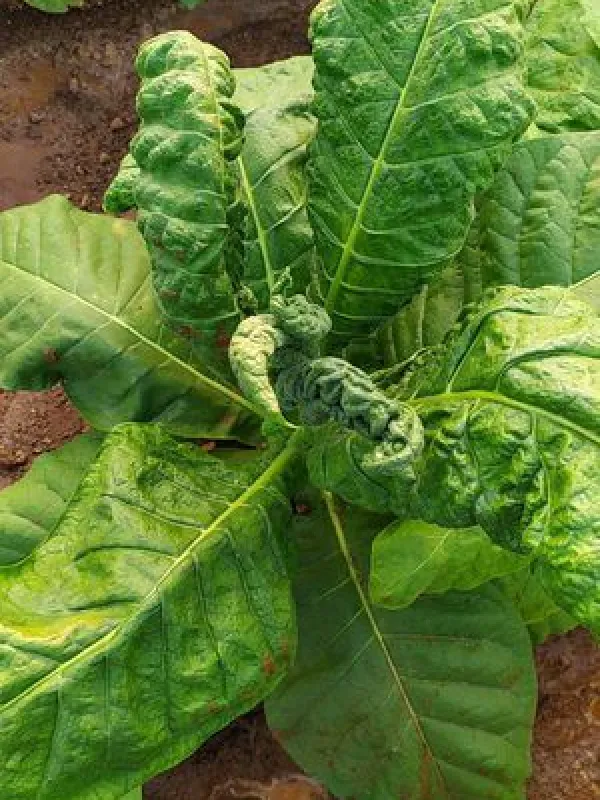
The primary symptom is a distinct downward or upward curling of the apical leaves. The leaves appear thickened, leathery, and often exhibit a puckered or crinkled texture that gives the disease its name.
Yellowing (chlorosis) between the leaf veins is a common diagnostic feature. The infected plants exhibit severe stunting, characterized by significantly shortened internodes and a stunted overall height.
In addition to curling, leaf veins may become prominent and sometimes show purpling or browning. As the disease progresses, the plant takes on a bushy, rosette-like appearance due to suppressed apical growth.
Flowering and bud development are often severely inhibited or disrupted, leading to the formation of malformed flowers and, in many cases, total sterility of the plant.
Signs are most prominent on the newest growth. Older leaves may show less severe symptoms, but the overall vigor of the plant is consistently low throughout the infection period.
Pathogen
The pathogen is a member of the Begomovirus genus within the Geminiviridae family. These viruses are characterized by a circular single-stranded DNA genome encapsulated in twinned virions.
It is an obligate parasite that relies entirely on the whitefly Bemisia tabaci for transmission. The virus cannot survive in the soil or infect plants through simple mechanical contact or seed transmission.
Once the vector feeds on an infected plant, the virus is ingested and travels through the insect's digestive tract into the hemolymph. Eventually, it reaches the salivary glands, where it remains for the duration of the insect's life.
This persistent, circulative mode of transmission means that a single whitefly can continue to infect healthy plants for several weeks, significantly increasing the potential for rapid outbreaks.
The virus is highly variable, and several distinct strains or species under the same complex can cause similar symptoms, often making field identification based on morphology alone challenging.
Conditions for development
The prevalence of the virus is directly correlated with the population dynamics of the whitefly vector. Hot, dry weather conditions provide the ideal environment for whitefly reproduction.
Weed hosts, especially those in the Solanaceae family, serve as critical reservoirs for the virus. During periods when no tobacco is planted, the virus survives within these wild plants.
Agricultural landscapes that mix tobacco with other host crops, such as tomatoes, peppers, or beans, facilitate a constant movement of virus-carrying whiteflies across different fields.
Prevailing winds can transport whiteflies over long distances, allowing the disease to spread into healthy plantations very quickly, even if local control measures are in place.
Lack of crop rotation or poor sanitation practices, such as leaving crop debris after harvest, allows the virus-vector complex to carry over from one growing season to the next.
Why it matters
The economic impact of this virus is severe, often resulting in complete loss of marketability for the tobacco crop. Malformed, stunted leaves have no commercial value as they lack the necessary physical qualities for processing.
Plants infected early in the season fail to produce a harvestable yield, leading to massive financial losses for growers. Late-stage infections still reduce yield quality and leaf size significantly.
The virus affects the chemical composition of the leaves, altering the nicotine content and flavor profile, which makes even visually passable leaves unsuitable for premium production.
Management costs increase substantially as growers are forced to implement intensive chemical control programs to suppress whitefly populations, further squeezing profit margins.
The threat of the virus often forces farmers to abandon certain growing regions or switch to less profitable varieties that happen to carry resistance traits, limiting production choices.
Protection
Integrated Pest Management (IPM) is essential for controlling this virus. The primary focus is the management of the Bemisia tabaci population through systemic insecticides applied early in the growth cycle.
Maintaining a host-free period by destroying crop residues and controlling reservoir weeds is a vital cultural practice to break the virus's life cycle and reduce initial inoculum levels.
Spatial separation of tobacco fields from other host crops is highly recommended. By creating distance, growers can significantly delay the arrival of migratory whiteflies from neighboring plots.
Regular monitoring using yellow sticky traps is a standard procedure to assess whitefly density. This allows for timely applications of insecticides before the vector population reaches the threshold for virus transmission.
The use of resistant or tolerant cultivars is the most sustainable and effective long-term solution. Whenever available, planting genetically improved varieties is the cornerstone of successful disease prevention.
Discussion
No discussions yet — be the first.