
Tobacco leaf curl virus
Begomovirus nicotianathailandense
Description
Symptoms
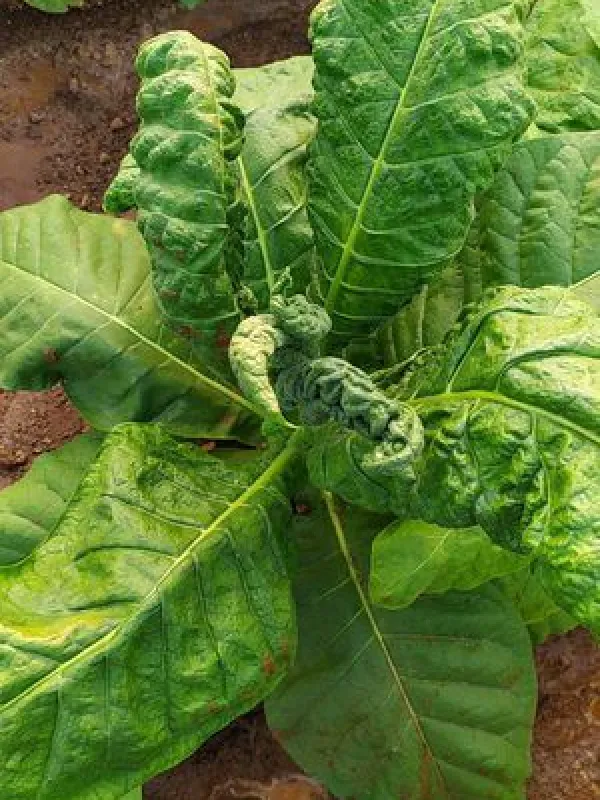
The earliest symptom is the curling and twisting of the apical leaves. The leaves appear stunted, crinkled, and exhibit significant deformation compared to healthy foliage.
Leaf veins often become thickened and exhibit a distinct clearing or yellowing, which contrasts with the dark green healthy tissue. Enations, or small leaf-like outgrowths, may form along the underside of the veins.
Infected plants show severe stunting. The internodes are significantly shortened, resulting in a bushy, dwarf appearance that prevents the plant from reaching its full potential height.
The photosynthetic capability of the plant is compromised, which often manifests as a pale color and a lack of vigor, leading to poor development of flowers and capsules.
- Curling and crinkling of the top leaves.
- Thickened and pale leaf veins.
- Stunted plant growth and shortened internodes.
- Leaf deformation and enation development.
Pathogen
The causal agent of this disease is the Nicotiana leaf curl virus, which belongs to the genus Begomovirus in the Geminiviridae family. It is a DNA virus that specifically targets and disrupts the physiological processes of the host plant.
It is a systemic viral disease. Once the virus enters the plant tissue, it translocates through the phloem to all parts of the plant, causing chronic developmental disorders.
The primary vector for the transmission of this virus is the whitefly Bemisia tabaci. The insect acquires the virus while feeding on infected sap and transmits it to healthy plants during subsequent feeding sessions.
The virus persists in reservoir hosts, primarily perennial weeds belonging to the Solanaceae family, which serve as a source of primary inoculum in the field during off-seasons.
The biological nature of geminiviruses allows them to manipulate the plant's hormonal balance, leading to the characteristic morphological changes observed in infected tobacco leaves.
Conditions for development
The incidence of the disease is highly correlated with the environmental conditions that favor the rapid reproduction and movement of the whitefly vector, Bemisia tabaci.
Warm, dry weather conditions are ideal for whitefly migration, leading to the rapid spread of the virus within and between neighboring tobacco fields.
The proximity of weed reservoirs, such as Solanum species, provides a consistent supply of viruliferous whiteflies, especially during the early stages of crop establishment.
High population densities of the whitefly in the surrounding environment increase the likelihood of secondary spread, making management more difficult during peak summer months.
Poor agricultural practices, such as overlapping growing seasons or lack of weed management, significantly contribute to the building up of the virus inoculum.
Why it matters
The economic impact is severe, as infected plants rarely produce marketable leaves. The systemic nature of the virus renders the entire plant unproductive in most cases.
The quality of the tobacco leaf is drastically reduced, affecting its texture, chemical composition, and curing properties, which renders it unsuitable for premium tobacco production.
Infection weakens the plant's natural defense systems, making it more susceptible to secondary infestations and opportunistic pathogens that further decrease yield potential.
Losses are compounded by the high cost of insecticide applications required to control the vector, which often proves insufficient once the virus is established in the field.
The disease also threatens other economically important Solanaceous crops, forcing farmers to avoid certain rotations and limiting their land usage options.
Protection
Effective management requires a multi-faceted approach, primarily focusing on suppressing whitefly populations through systemic insecticide applications and field sanitation.
Removing weed reservoirs from the field edges and surrounding areas is crucial for reducing the primary source of the virus before the tobacco crop is planted.
Field monitoring and the immediate removal of symptomatic plants are essential practices to limit the spread of the virus from the initial foci of infection.
Utilizing resistant or tolerant tobacco varieties is the most sustainable and efficient strategy for mitigating losses without relying heavily on chemical pesticides.
Implementing spatial isolation between younger and older tobacco crops helps in preventing the movement of whiteflies from highly infested areas to healthy ones.
Discussion
No discussions yet — be the first.