
Cassava mosaic Zanzibar virus
Begomovirus manihotiszanzibarense
Description
Symptoms
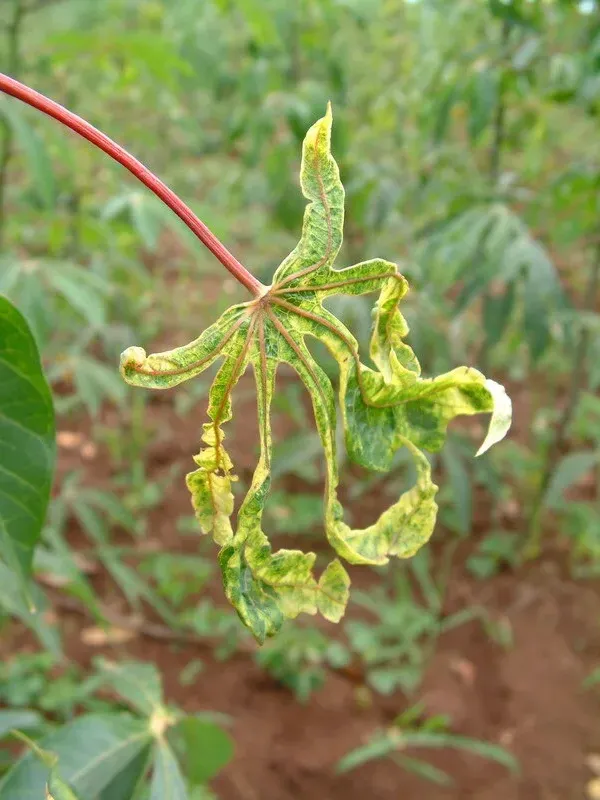
The primary symptom is a mosaic pattern of chlorotic (yellowish) and green patches on the leaves. This chlorosis often follows the veins of the leaf, giving it a mottled appearance.
As the infection progresses, leaves exhibit significant distortion, including curling, twisting, and a reduction in size. This distortion is caused by the virus disrupting the leaf's developmental signaling pathways.
Stunting is a hallmark of the disease. Infected cassava plants typically have shortened internodes, resulting in a bushy, low-growing appearance that is markedly different from healthy plants.
- Yellow or pale mosaic leaf spotting.
- Severe leaf curling and crinkling.
- Stunted plant height and reduced biomass.
- Reduced branching of the main stem.
- Deformed and underdeveloped storage roots.
The severity of these symptoms can vary depending on the host's sensitivity, the virus strain, and the environmental conditions during the initial infection period.
Pathogen
The disease is caused by a specific virus within the Begomovirus genus, commonly associated with the Cassava mosaic Zanzibar virus complex. This DNA virus is a significant agricultural pathogen affecting the Manihot esculenta species.
Transmission occurs primarily through the whitefly Bemisia tabaci in a circulative-persistent manner. Once the insect ingests the viral particles from an infected leaf, it remains a vector for the rest of its lifespan, facilitating rapid spread.
The virus replicates within the host's cells, disrupting normal metabolic processes. Due to its complex DNA genome, the virus frequently undergoes recombination, leading to the emergence of more virulent strains.
Systemic movement within the plant ensures that the virus spreads to all organs, including the tubers used for propagation. This makes vegetative reproduction a major pathway for the disease's persistence in agricultural systems.
Biological research indicates that the virus requires specific conditions within the host cell for replication, making the interaction between the virus, the host plant, and the insect vector a critical area for ongoing agricultural studies.
Conditions for development
High populations of Bemisia tabaci are the primary condition for a widespread epidemic. Climate factors that promote rapid whitefly reproduction—such as high temperatures and moderate humidity—accelerate the disease.
Continuous cropping of cassava in the same fields creates a permanent host reservoir. Without a fallow period, the virus remains within the soil-resident plant debris and nearby alternative host plants.
Poor agricultural practices, such as failing to remove infected plants or using uncertified cuttings, are major drivers for transmission. Dense planting configurations also allow whiteflies to move easily between plants.
The presence of wild host plants, particularly within the Euphorbiaceae family, can maintain the virus reservoir even when no cassava is present, facilitating reinfection of new crops.
Environmental stress on the host plant can sometimes exacerbate the symptoms, as the plant's natural defense mechanisms are weakened, allowing for a faster viral titer buildup.
Why it matters
The economic impact of the virus is severe, with yield losses often ranging from 20% to over 80%. This directly affects food security in regions where cassava is a staple crop.
Beyond quantity, the quality of the cassava roots is compromised. The accumulation of starch in the storage roots is significantly reduced, making them less valuable for market or industrial use.
Infected crops show decreased vigor and increased susceptibility to other biotic and abiotic stresses. This can lead to total crop failure under adverse conditions, forcing economic hardship on smallholder farmers.
The disease cycle is cumulative. Using cuttings from infected plants for subsequent seasons ensures that the virus becomes a permanent fixture on the farm, leading to long-term productivity decline.
Export potential is also limited in areas where this virus is endemic, as international phytosanitary regulations restrict the movement of plant material from infected zones to prevent global spread.
Protection
The use of clean, virus-free planting material is the foundation of management. Establishing nurseries that utilize tissue culture or indexed healthy cuttings is essential for controlling primary infection.
Integrated pest management (IPM) focusing on the control of Bemisia tabaci is necessary. This involves using biological controls, such as parasitoids, and selective insecticide application when necessary.
Rogueing—the systematic removal and destruction of symptomatic plants—is a critical practice. If carried out early and consistently, it can significantly reduce the viral load within a field.
Breeding and deploying resistant cassava varieties remains the most sustainable and effective long-term solution. Many national research programs are currently focused on introgressing resistance genes into local cassava cultivars.
Promoting good agricultural practices, such as crop rotation and spatial isolation of new plantations from older ones, helps to break the disease cycle and protects the next generation of crops.
Discussion
No discussions yet — be the first.