
Madagascar cassava mosaic
Begomovirus manihotismadagascarense
Description
Symptoms
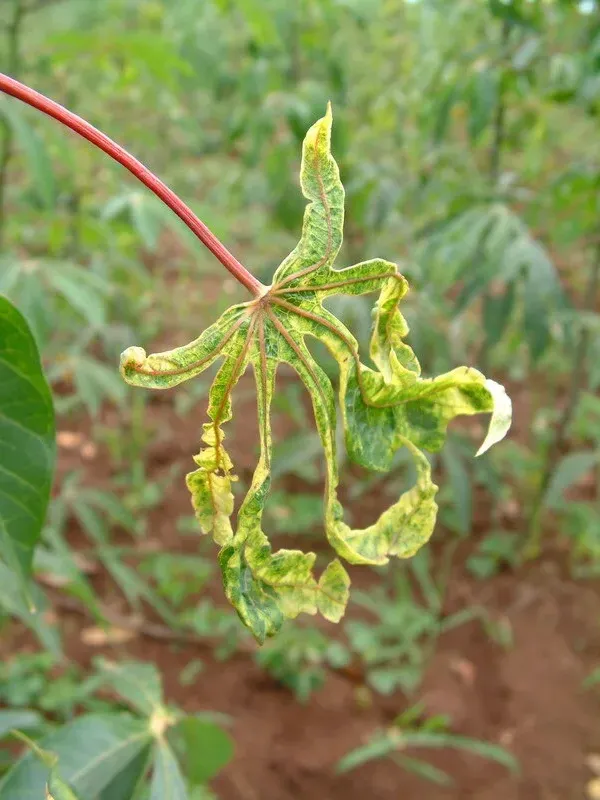
The primary symptom is the appearance of a characteristic chlorotic mosaic on the leaves. The leaf blade acquires a mottled appearance with alternating yellow, light green, and normal green areas.
Significant deformation and leaf curling are observed. The leaves often become asymmetrical, their edges curl, and the blades decrease in size, reducing the photosynthetic surface.
The plant as a whole lags significantly in growth and development. Internodes become shortened, and the shrub takes on a stunted, dwarfed appearance, contrasting sharply with healthy, vigorously growing individuals.
As the disease progresses, premature leaf drop may occur, leaving the stem bare. The appearance of the affected field is characterized by an uneven canopy and widespread yellowing of the plants.
On roots and tubers, visual symptoms are weak, but their mass decreases significantly. The quality of marketable produce drops, making the harvest unsuitable for processing or commercial sale.
Pathogen
The causal agent of this disease is the African cassava mosaic Madagascar virus (ACMMaV), which belongs to the genus Begomovirus in the Geminiviridae family. It is a single-stranded DNA virus that primarily infects plants of the Manihot genus.
The disease is classified as a viral mosaic, transmitted by specific insect vectors. Under natural conditions, the virus circulates within the cassava population, persisting in infected vegetative parts and tubers.
The primary vector for the transmission of the infection in the field is the whitefly Bemisia tabaci. The insect feeds on the sap of an infected plant, acquires the virus, and then transmits it to healthy specimens during subsequent feeding.
The virus genome is characterized by high plasticity, which allows it to adapt to local conditions in Madagascar. Studying the molecular structure of the virus is crucial for developing diagnostic test systems.
The spread of the virus also occurs through the use of infected planting material. Using cuttings from diseased plants guarantees the infection of new plantings at the early stages of development.
Conditions for development
The development of the virus is facilitated by the high temperatures and moderate humidity characteristic of the tropical climate of Madagascar. These conditions stimulate the active reproduction of whiteflies.
Massive whitefly outbreaks are a critical factor in the spread of the virus. The higher the population density of insects per hectare, the faster the virus covers the entire plantation area.
The lack of crop rotation and the cultivation of susceptible cassava varieties for many years create a favorable environment for the accumulation of the viral infection in the soil and surrounding areas.
Failure to timely remove weeds, which can act as intermediate hosts for the virus or reservoirs for whiteflies, accelerates the process of primary infection of young plantings.
Poor agricultural practices, including overcrowding, create a microclimate with high humidity within the plant canopy, which promotes the development of infection vectors.
Why it matters
The main damage lies in a significant reduction in cassava tuber yield. The virus disrupts the plant's metabolism, redistributing nutrients to favor the pathogen rather than the formation of the marketable part of the harvest.
Reduced photosynthesis due to leaf damage leads to the poor development of the root system. This makes plants less resistant to adverse abiotic factors such as drought or nutrient deficiencies.
Economic losses for smallholder farmers can reach 50-80% of the potential yield in epidemic years. This threatens the food security of regions where cassava is a dietary staple.
Infection of planting material leads to the accumulation of the virus from generation to generation. Eventually, this makes it impossible to grow cassava on a specific plot without completely replacing the seed stock.
The quality of starch obtained from infected tubers is often below standard requirements, which reduces export value and limits opportunities for deep processing of the raw material.
Protection
The main control method is the use of virus-free planting material obtained through tissue culture or meristem propagation. This is the only way to break the transmission cycle via cuttings.
Implementation of phytosanitary measures is recommended, such as regular field inspections and immediate removal of affected plants, followed by their destruction outside the field to prevent the spread of the infection.
Control of the vector, Bemisia tabaci, is vital. The application of systemic insecticides during the early stages of vegetation helps to keep pest populations in check and reduce the rate of viral transmission.
The breeding and introduction of cassava varieties resistant to Madagascar mosaic is the most promising direction for crop protection, allowing for the minimization of chemical inputs.
- Maintaining spatial isolation between new and old cassava plots.
- Timely weeding to remove alternative viral hosts.
- Training local producers in methods of recognizing mosaic symptoms.
- Organizing monitoring of whitefly populations using yellow sticky traps.
Discussion
No discussions yet — be the first.