
Burkina Faso cassava mosaic
Begomovirus manihotisburkinafasoense
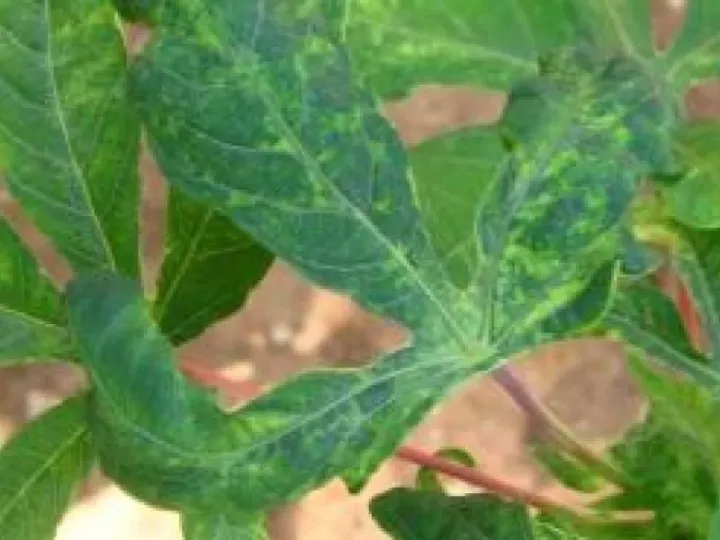
Description
Symptoms
The primary symptom of the disease is a characteristic mosaic pattern on leaves, appearing as a mixture of light green, yellow, and dark green spots. Infected leaf blades often exhibit deformation, curling, and a significant reduction in overall surface area.
As the disease progresses, plants show a marked reduction in growth. Internodes become shortened, giving the cassava plant a stunted, shrub-like appearance which makes it clearly distinguishable from healthy vegetation.
In severe infection cases, premature leaf shedding occurs. This leads to stem defoliation, which severely limits the plant's ability to perform photosynthesis, ultimately weakening the entire crop.
Root system development is severely hampered in affected plants. Tuber formation is significantly delayed or completely halted, resulting in small, fibrous tubers that are unsuitable for consumption or commercial processing.
In the field, diseased plants may appear in localized patches or scattered throughout the plantation, depending on the movement patterns of the viral vector during the growing season.
Pathogen
The causative agent of this disease is Begomovirus manihotisburkinafasoense, a member of the Geminiviridae family. It is a single-stranded DNA virus specifically adapted to infect the Manihot genus.
The virus is transmitted by the whitefly Bemisia tabaci. The insect acquires the virus while feeding on the phloem sap of an infected plant and subsequently transfers it to healthy plants during further feeding activities.
The virus demonstrates a high degree of genetic variability, which poses significant challenges for traditional breeding programs aimed at developing resistant cassava varieties.
In addition to vector-mediated spread, the virus is easily disseminated through contaminated propagation material. Using cuttings from diseased plants creates a continuous cycle of infection in new fields.
The molecular mechanism of the virus involves hijacking the host plant's cellular machinery for viral replication, which not only disrupts normal physiological processes but also suppresses the plant's natural defense responses.
Conditions for development
The spread of the disease is closely linked to the population density of the whitefly vector. High temperatures and moderate humidity are conducive to rapid multiplication of these insects.
The use of uncertified planting material is the most significant factor in disease dispersal. Farmers unknowingly spread the pathogen by planting infected stems across large agricultural areas.
Poor agronomic practices, such as lack of crop rotation and continuous mono-cropping, contribute to the buildup of viral inoculum in the environment, increasing the risk of insect-mediated transmission.
The presence of wild host plants or weeds nearby serves as a reservoir for both the virus and the whitefly, maintaining a constant source of infection that threatens nearby cassava fields.
High-density planting creates microclimates with increased humidity levels, which are favorable for whitefly survival and movement within the canopy, thereby accelerating the disease spread.
Why it matters
Burkina Faso cassava mosaic causes substantial economic damage, with yield losses ranging from 40% to 80% depending on the susceptibility of the cultivar and the timing of the initial infection.
Beyond yield reduction, the quality of the harvested tubers is significantly degraded. A decrease in starch content affects the industrial value of the cassava, making it less suitable for processing.
The disease leads to the degeneration of cassava varieties over time. Continued propagation from infected mother plants results in a cumulative decline in yield quality across successive generations.
On a national or regional scale, the disease poses a threat to food security. Given that cassava is a staple crop, widespread infections can lead to severe shortages and economic instability for farming communities.
Financial losses are further exacerbated by the high costs associated with management, including the need for pesticide application and the replanting of destroyed infected fields.
Protection
The primary control measure is the use of healthy, virus-indexed planting material. Utilizing certified clean cuttings is the most effective way to prevent the disease from establishing in new areas.
Regular monitoring of plantations for whitefly populations is essential. If insect numbers exceed certain thresholds, the strategic application of insecticides is required to curb transmission.
Roguing, or the systematic removal and destruction of infected plants, should be performed as soon as symptoms appear to prevent secondary spread from the initial disease foci.
Developing and deploying genetically resistant cultivars through breeding programs is the most sustainable and cost-effective approach for long-term disease management in affected regions.
Implementing spatial isolation between newly planted fields and older infected crops helps to reduce the rate of virus movement by limiting the travel distance for the whitefly vectors.
Discussion
No discussions yet — be the first.