
Papaya begomovirus
Begomovirus caricaguandongense
Description
Symptoms
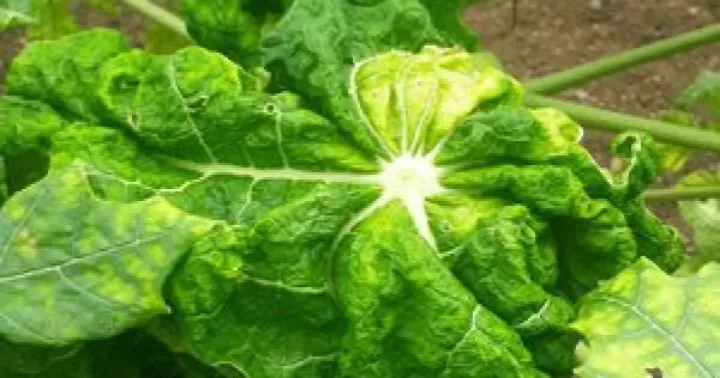
The primary symptom of infection is a characteristic mosaic pattern on leaf blades, often accompanied by tissue yellowing. Early symptoms may be subtle, complicating early detection.
Severe leaf curling is observed, with margins rolling upwards or downwards, causing leaf deformation. This significantly reduces the photosynthetic surface area required for plant growth.
Plants show clear signs of stunted growth and dwarfism. Internodes become shortened, giving the plant an abnormally dense, "brush-like" appearance.
Fruits on infected plants are small, frequently deformed, and unsuitable for the market. The quality of the papaya pulp is significantly reduced, rendering the crop economically unviable.
- Vein yellowing (veinal chlorosis)
- Leaf margin curling
- Stunted shoot growth
- Reduced fruit marketability
Pathogen
The causative agent of the disease is Begomovirus caricaguandongense, a virus belonging to the Geminiviridae family. It is a single-stranded DNA virus with high specificity for the Caricaceae family.
The virus is transmitted exclusively through a semi-persistent mechanism by a specific vector, the whitefly Bemisia tabaci. The virus is not mechanically transmitted via sap or seeds, making vector control vital.
The virus's genetic structure enables rapid adaptation to environmental conditions, specifically targeting young plant tissues. Viral particles accumulate in phloem cells, disrupting nutrient transport.
The biology of the pathogen is closely tied to the lifecycle of the whitefly, which acts as the primary infection reservoir. Outside the insect vector, the virus maintains stability for a very limited time.
This disease belongs to the leaf curl and yellowing virus group typical of begomoviruses. The infection triggers a systemic immune response, which, unfortunately, cannot halt disease progression.
Conditions for development
Virus development is directly dependent on whitefly population density in plantations. High temperatures and dry spells create ideal conditions for rapid vector reproduction.
In regions with tropical climates, where there is no winter pause in insect development, the virus can spread year-round. This necessitates constant field monitoring.
The presence of weeds around papaya plantings provides the virus with reservoir hosts during the off-season. Many weeds can act as asymptomatic carriers of the virus.
Poor agronomic practices, including excessive nitrogen fertilization, promote the growth of succulent foliage, which is highly attractive to whiteflies.
Virus spread is exacerbated by windy weather, which carries winged whiteflies over long distances from primary infection epicenters.
Why it matters
Papaya begomovirus poses a severe threat to commercial papaya plantations. Yield losses can reach 80-100 percent if young seedlings are infected early.
Infection renders the plantation unproductive, as there are no effective cures for already infected plants. The agronomic strategy must focus entirely on prevention.
Crop damage leads to a drastic shortening of the papaya's reproductive period. Infected plants often die before reaching the mass-fruiting stage or produce non-marketable fruit.
Beyond direct economic loss, infected crops become a persistent source of infection for new plantings, forcing farmers to eradicate entire fields to contain the virus.
The high cost of vector protection increases the final cost of production. Furthermore, the inability to control the virus limits export opportunities to regions free from the infection.
Protection
The cornerstone of protection is the use of certified healthy planting material. Only virus-free seedlings can provide a full harvest in risk areas.
It is critical to carry out regular chemical or biological treatments against whiteflies using systemic insecticides. Rotating pesticides is essential to prevent the development of pest resistance.
An important technique is the use of insect-proof nets or protective covers in nurseries during early growth stages. This mechanically prevents plant contact with vectors.
Strict phytosanitary protocols must be followed, including timely destruction of weeds and harvest residues. Infected plants should be immediately removed from the field and destroyed.
The use of resistant or tolerant cultivars remains the most promising path for long-term control. Monitoring pest populations with sticky traps allows for precise treatment applications only when thresholds are met.
Discussion
No discussions yet — be the first.