
Beet yellows virus
Beet severe curly top virus
Description
Symptoms
The first symptoms appear on the lower and middle leaves of the rosette as chlorosis (yellowing) of the interveinal tissue. It is characteristic that the veins remain green for a long time, creating a specific high-contrast pattern.
Affected leaves become brittle, lose turgor, and break easily when bent. Over time, the yellowing spreads across the entire leaf blade, which eventually turns orange or brownish in color.
With severe development of the disease, premature senescence and dropping of infected leaves occur. The beet rosette noticeably shrinks, and new leaves emerge stunted and chlorotic.
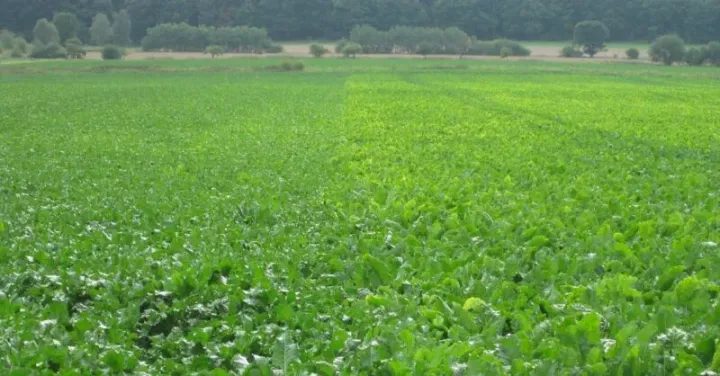
In field conditions, the disease often appears in patches, as the initial insect vectors colonize specific areas of the crop. As the aphid population spreads, the infection encompasses larger areas of the field.
Infected roots exhibit reduced sugar accumulation and poorer overall product quality, which significantly decreases sugar yield during industrial processing.
Pathogen
The causative agent of the disease is the Beet yellows virus (BYV), belonging to the Closterovirus genus. This virus consists of filamentous particles and is not transmitted mechanically through sap or seeds, spreading exclusively in a persistent manner.
The primary vector for the transmission of the infection is the green peach aphid or the black bean aphid. The virus persists in the insect's body for several days, which allows aphids to transport the pathogen over significant distances.
Reservoirs of infection in nature include overwintering weeds from the Amaranthaceae family, as well as seed-bearing beets planted near commercial fields. Primary field infestation usually begins from these localized sources in the spring.
The pathogen infects the root system and vascular bundles, disrupting the translocation of photosynthates. This results in a systemic infection of the entire plant that persists until the end of the growing season.
Diagnostics for the disease involve ELISA or PCR testing, as visual symptoms can often be confused with nutrient deficiencies or physiological disorders.
Conditions for development
The development of Beet yellows virus epidemics is directly dependent on aphid population density. Hot and dry weather conditions promote rapid reproduction of vectors and their active migration into sugar beet fields.
The most critical window for infection occurs from late spring to mid-summer. A high density of weeds along field margins creates ideal conditions for the virus to survive during the off-season.
The absence of crop rotation and proximity of commercial sugar beet fields to overwintered seed beets provoke early and massive infection of young plants at the 4-6 leaf stage.
Balanced fertilization and high levels of crop management do not prevent infection, but they help plants maintain physiological activity for longer, slowing the progression of the viral process.
Integrated pest management in early summer is critically important, as stopping virus spread with chemical sprays becomes nearly impossible after the aphid population is established.
Why it matters
The damage caused by Beet yellows virus consists of a sharp reduction in the photosynthetic leaf surface area. This leads to lower root mass and a significant reduction in sugar content.
Crop losses in heavily infected areas can reach 30–50%. Early infection is particularly dangerous as it almost completely blocks the formation of the productive portion of the plant.
The technological quality of the raw material deteriorates, including lower juice purity and increased levels of harmful nitrogenous compounds, which complicates sugar crystallization at the factory.
The virus significantly weakens the plant's immune system, making it more susceptible to fungal diseases such as Cercospora leaf spot or Phoma, leading to secondary rot.
Produce harvested from heavily infected fields is unsuitable for long-term storage, as roots have poor shelf life and are prone to rapid wilting.
Protection
The foundation of protection is spatial isolation of sugar beet crops from seed-bearing beets of previous years. A distance of at least 1–2 kilometers is recommended to minimize the risk of infection transfer.
Thorough control of weeds from the Amaranthaceae family (such as lamb's quarters) is essential, as they serve as the primary virus reservoirs in spring before beet sprouts appear.
Insecticide application against aphids must be timely, based on pest monitoring data. Initial treatments are most effective during the migration period of winged aphid vectors.
Cultivation of resistant or tolerant sugar beet hybrids is recommended, as these varieties can maintain productivity even when subjected to viral stress.
- Practice crop rotation and avoid monocropping
- Eliminate volunteer beet plants during autumn
- Monitor field margins for aphid presence
- Apply nitrogen fertilizers in a balanced manner
Discussion
No discussions yet — be the first.