
Description
Symptoms
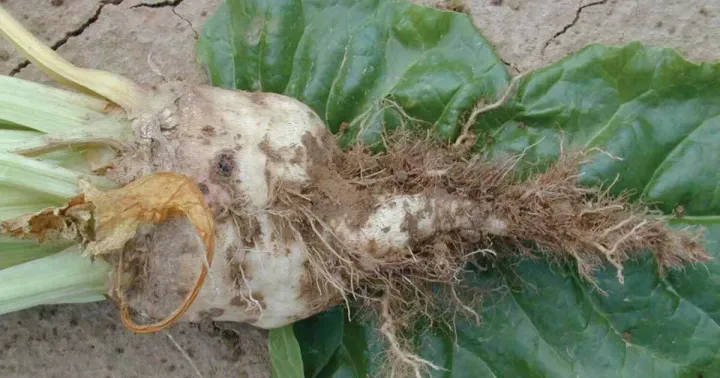
The classic symptom that gives the disease its name, "Rhizomania" (root madness), is the excessive proliferation of fine, hair-like lateral roots on the taproot.
The taproot itself is typically stunted and thin, failing to develop properly, and often exhibits a characteristic constriction towards the tip.
Internal symptoms include vascular browning, where the vascular bundles turn dark brown or black, which is highly visible on the cross-section of the root.
Foliar symptoms may include mild yellowing or chlorotic spotting on leaves, but these are often fleeting and unreliable for diagnostic purposes.
Stunting of the entire plant is common, with affected beets often exhibiting an upright, narrow leaf habit compared to the spreading canopy of healthy plants.
Pathogen
The disease known as Rhizomania is caused by the Beet necrotic yellow vein virus (BNYVV), which is transmitted by a soil-borne plasmodiophorid fungus called Polymyxa betae.
The virus particles are carried within the resting spores of the fungus, which can persist in the soil for over a decade, making the pathogen extremely difficult to eradicate.
Apart from sugar beet, the virus is known to affect other Chenopodiaceae family members, including spinach (Spinacia oleracea), which can act as a natural host.
The fungus acts as both the vector and the reservoir, ensuring the survival of the virus across adverse environmental conditions and non-host crop seasons.
The infection process is systemic, as the virus spreads through the vascular tissues of the plant, disrupting physiological functions and nutrient transport.
Conditions for development
Rhizomania development is highly dependent on high soil moisture levels, as the zoospores of Polymyxa betae require free water to swim through soil pores.
Areas of fields that are prone to waterlogging or compaction are significantly more susceptible to outbreaks of the disease.
The optimum temperature for the fungus and the virus to interact and infect plant roots ranges between 15°C and 25°C.
Frequent rainfall or excessive irrigation during the early stages of crop development dramatically increases the risk and severity of the viral infection.
Soil pH and structure play a role; while the virus is widespread, it thrives best in environments where the fungal vector finds sufficient moisture and root access.
Why it matters
The primary economic impact is a massive reduction in root yield, which can exceed 50% in heavily infested soils if non-resistant varieties are used.
Sugar content is significantly lowered, as the virus impairs the plant's ability to store carbohydrates effectively in the taproot.
Quality issues, such as poor storability and susceptibility to secondary rot, lead to significant losses during the processing phase at sugar factories.
Once a field is infested with the virus-carrying fungus, the land is virtually limited to the production of rhizomania-resistant varieties for many years.
The disease poses a long-term threat to agricultural sustainability in sugar beet-growing regions due to the persistence of the pathogen in the soil.
Protection
The most important control strategy is the use of genetically resistant or tolerant sugar beet hybrids, which are specifically bred to maintain yield under virus pressure.
Rigorous sanitation measures are necessary, such as cleaning machinery between fields to prevent the movement of infested soil into clean areas.
Improved field drainage is essential to reduce the conditions that favor the fungus, thereby lowering the probability of initial infection.
Implementation of long crop rotations is advised, although it is rarely sufficient to eliminate the resting spores of Polymyxa betae completely.
Integrated management plans should focus on combining resistance with optimal agricultural practices to minimize the impact of the disease on profitability.
Pathogens and affected parts
Affects crops · 1
Discussion
No discussions yet — be the first.