
Banana bunchy top virus
Babuvirus musae
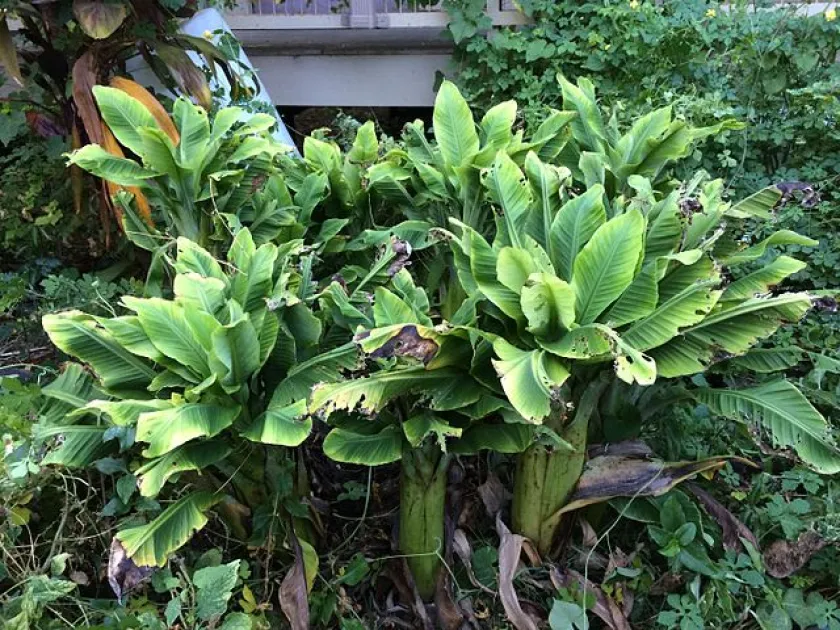
Description
Symptoms
The initial symptoms appear as narrow, short, and chlorotic streaks on the leaf veins, which eventually coalesce into broken, dashed lines.
As the infection progresses, new leaves emerge progressively smaller, narrower, and more yellowish, often with upward-curling edges.
A hallmark sign is the tight clustering of leaves at the top of the plant, which creates the characteristic "rosette" or "bunchy" appearance.
Infected plants exhibit severe stunting and often fail to produce any fruit; if a fruit bunch does develop, it is typically deformed and stunted.
Advanced stages of the disease show chlorosis extending into the petioles and the pseudostem, leading to the eventual decline of the plant structure.
Pathogen
The disease is caused by the Banana bunchy top virus (BBTV), which belongs to the genus Babuvirus within the Nanoviridae family.
The virus consists of a single-stranded circular DNA genome and is recognized as the most severe viral disease affecting banana crops globally.
The primary vector for the virus is the banana aphid, Pentalonia nigronervosa, which acquires the virus by feeding on the sap of infected plants.
Transmission is persistent; once an aphid acquires the virus, it remains infectious for the rest of its life, although it does not pass the virus to its offspring.
Mechanical transmission via tools or handling is extremely rare, making insect vectors and contaminated planting material the main routes of spread.
Conditions for development
Disease development is heavily reliant on the population density of the banana aphid, which thrives in warm and humid tropical environments.
The spread of BBTV occurs primarily through the movement of infected vegetative propagules, such as suckers or rhizomes, across different areas.
High air humidity and moderate temperatures provide optimal conditions for aphid reproduction, accelerating the secondary spread of the virus.
Poorly maintained plantations with significant weed pressure provide refuge for aphid vectors, sustaining the viral reservoir throughout the year.
The lack of strict quarantine measures and the importation of infected banana stock are the primary factors leading to the introduction of BBTV into new zones.
Why it matters
Banana bunchy top is a destructive disease that can result in total crop failure if left unmanaged within a banana plantation.
The virus interferes with the host's physiological processes, causing severe disruption in nutrient transport and inhibiting fruit development.
Economic damage is profound, as it necessitates the eradication of entire infected plantations and may lead to long-term quarantine restrictions.
Since the virus is highly contagious via its aphid vector, a single infected plant poses a significant threat to all neighboring healthy plants.
The cost of re-establishing a virus-free plantation is substantial, making prevention a critical economic priority for banana producers.
Protection
The most effective strategy is the use of healthy, virus-free planting material produced through certified tissue culture and meristematic propagation.
Strict quarantine regulations must be enforced to restrict the movement of banana plants from known endemic or infested regions.
If infection is detected, affected plants must be completely eradicated, including the root systems, to ensure no vectors remain to feed on infected tissue.
Managing the banana aphid population using integrated pest management techniques, including targeted insecticide application, helps minimize viral transmission.
Continuous monitoring of plantations for early symptoms of the virus is essential for the rapid containment and eradication of localized outbreaks.
Discussion
No discussions yet — be the first.