
Cardamom bushy dwarf virus
Babuvirus cardamomi
Description
Symptoms
The hallmark symptom of this disease is severe stunting, where the plant fails to reach its full height. The internodes become significantly shortened, giving the plant a compact and compressed appearance.
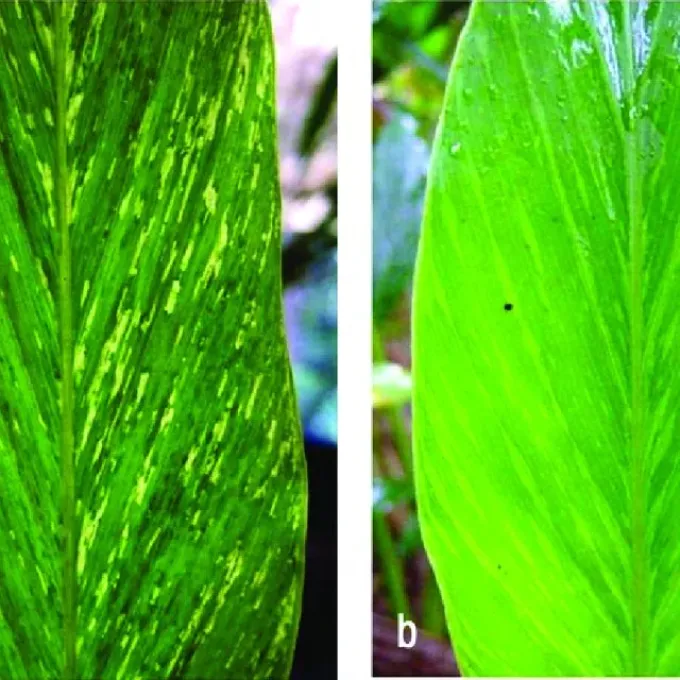
Leaves on infected plants are generally smaller than normal, exhibiting chlorotic streaks or mosaic patterns. In advanced stages, leaves may become thick, leathery, and display distinct curling or distortion.
Infected plants often develop a "bushy" appearance due to the proliferation of numerous side shoots that fail to grow properly. This excessive tillering leads to a dense, stunted cluster of foliage.
The root system of infected plants is typically underdeveloped and compromised. This leads to reduced nutrient and water uptake, causing the plant to appear wilted even when soil moisture is adequate.
Flowering is severely suppressed in infected plants. If pods are produced, they are usually underdeveloped, malformed, and often fall off prematurely, resulting in a complete loss of marketable yield.
Pathogen
The causative agent of the disease is the Cardamom bushy dwarf virus, a member of the Babuvirus genus within the Nanoviridae family. It is a single-stranded circular DNA virus known for causing severe stunting in cardamom plants.
The primary vector for this viral disease is the banana aphid, Pentalonia nigronervosa. The aphid acquires the virus by feeding on infected plants and subsequently transmits it to healthy cardamom through its saliva.
The virus colonizes the plant's phloem, which serves as the vascular tissue for transporting nutrients. Once infected, the virus spreads systemically throughout the entire plant, affecting all developmental stages.
Mechanical transmission via tools or handling is not considered a significant route for this virus. The primary mode of long-distance spread is the movement of infected rhizomes used for new plantation propagation.
The virus's biological life cycle is tightly coupled with its aphid vector. High humidity and favorable temperature regimes support large aphid populations, facilitating rapid disease transmission across cardamom farms.
Conditions for development
Outbreaks of Cardamom bushy dwarf virus are highly correlated with the prevalence of the banana aphid. Conditions that favor aphid reproduction, such as moderate temperatures and high humidity, lead to increased infection rates.
Dense planting configurations provide shelter for aphids within the leaf sheaths, making them difficult to detect and eradicate. This microclimate is conducive to the establishment of the virus within the farm.
Weeds present in or near the plantation can serve as alternative hosts for both the aphid vector and the virus. Neglected farm sanitation acts as a reservoir, allowing the disease to persist between cropping seasons.
Optimal virus replication usually occurs within a temperature range of 20–30°C. During these warm periods, the rapid turnover of aphid generations leads to an exponential increase in secondary infections.
Poor agricultural practices, such as excessive nitrogen application, can produce succulent growth that is highly attractive to aphids, thereby increasing the probability of successful virus inoculation.
Why it matters
Cardamom bushy dwarf virus is one of the most destructive diseases for cardamom growers worldwide. It can lead to the total collapse of a plantation within a few years if not managed correctly.
The economic impact is severe due to the loss of both quantity and quality of the harvest. Infected plants produce negligible yields, and the capsules produced are unsuitable for essential oil extraction.
Plants weakened by the virus are more susceptible to secondary infections, such as rhizome rot and various fungal pathogens. This synergy further complicates the recovery and management of the farm.
Resource depletion in the rhizome due to impaired photosynthesis leads to the eventual death of the plant. This forces farmers to abandon contaminated plots and invest in expensive replanting efforts.
The cost of managing the disease, including frequent pesticide application and labor-intensive plant removal, significantly erodes the profit margins of cardamom producers.
Protection
The most crucial strategy is the use of virus-free, tissue-cultured planting material. Ensuring that new plantations are started with certified, healthy rhizomes is the best insurance against the disease.
Integrated Pest Management (IPM) is essential to control the banana aphid population. Regular monitoring and targeted systemic insecticide applications should be employed during peak aphid migration periods.
Sanitation is key; any plant exhibiting symptoms must be rogued out immediately. The entire plant, including the rhizome, should be carefully removed and burned to prevent the spread to adjacent healthy plants.
Establishing buffer zones and practicing spatial isolation between older, infested blocks and new plantations can significantly reduce the risk of vector-borne spread.
- Regular weeding to remove alternative host plants.
- Use of aphid-trapping methods for early detection.
- Training staff in identifying early symptoms of bushy dwarf.
- Adherence to strict quarantine protocols for incoming plant materials.
Discussion
No discussions yet — be the first.