
Arcyria nutans
Arcyria nutans
Description
Symptoms
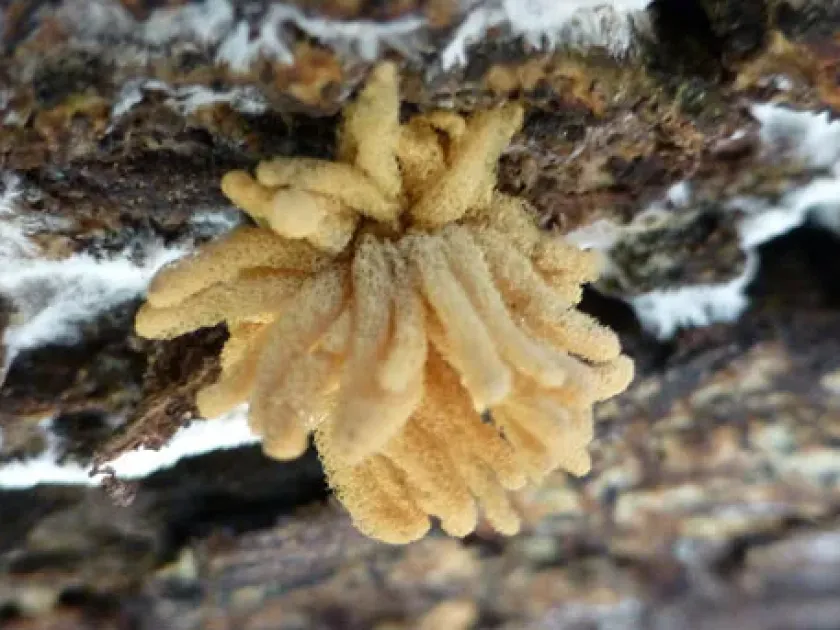
Dense clusters of sporangia appear on the surface of substrates, most often rotting wood, which gradually lengthen and become loose.
Initially bright-colored, the fruiting bodies eventually acquire a duller, ocher-brown hue due to the release of spores.
Upon contact, mature sporangia crumble easily, forming a cloud of fine dust — the spores of the slime mold.
Mycelial threads (capillitium) within the sporangia provide elasticity to the structure, which is an important morphological feature of the species.
Unlike true fungal diseases, there are no necroses, chloroses, or wilting of the plant tissues themselves.
Pathogen
Arcyria nutans is not a classic plant disease pathogen. It is a species of slime mold, or myxomycete, belonging to the kingdom Protista.
The organism passes through a plasmodium stage — a mobile multinucleate cytoplasmic mass that feeds by phagocytosis, consuming bacteria and fungal spores.
During the fruiting phase, the myxomycete forms characteristic sporangia, which have an elongated, cylindrical shape and a bright yellow or ocher color.
The life cycle includes sporulation, during which spores are dispersed by wind or insects for further germination in a favorable environment.
It is important to understand that Arcyria is a saprotroph, not a parasite, and therefore it does not attack living plant tissues directly.
Conditions for development
The development of Arcyria requires high humidity, making damp forests and shaded garden areas ideal habitats.
Deciduous deadwood that is in an active state of decay serves as an optimal substrate.
The presence of a rich microflora (bacteria and fungi) on the substrate stimulates the development of the myxomycete, as they serve as its primary food source.
The temperate climate temperature regime promotes the mass appearance of fruiting bodies in late summer and autumn.
The absence of direct sunlight and good aeration of the damp wood layer contribute to the rapid completion of the species' life cycle.
Why it matters
For living agricultural crops, Arcyria nutans poses no direct biological threat and is not a phytopathogen.
In agroecosystems, the presence of this species indicates the presence of excessive amounts of rotting organic matter.
On decorative objects, the presence of slime mold may be perceived as an aesthetic issue that spoils the appearance of wooden landscape elements.
The indirect harm lies in the possible fouling of plant surfaces with spores, which sometimes hinders normal photosynthesis if the spore layer is too dense.
Overall, this object is considered a useful decomposer that accelerates the mineralization of dead wood in forest and peri-forest ecosystems.
Protection
Specific control measures for Arcyria as a "disease" are not required, as it does not cause damage to cultivated plants.
The main preventive method is the timely sanitary cleaning of the site from rotting wood, stumps, and woody debris.
Lowering humidity levels in problematic areas and ensuring good soil drainage prevent the active reproduction of slime molds.
In case of massive spore accumulation on decorative surfaces, mechanical removal with a dry brush or washing with water is sufficient.
- Regular pruning of old branches.
- Disposal of rotting wood outside the site.
- Improving ventilation of the root zone.
Discussion
No discussions yet — be the first.