
Pear blister canker
Apscaviroid pustulapyri
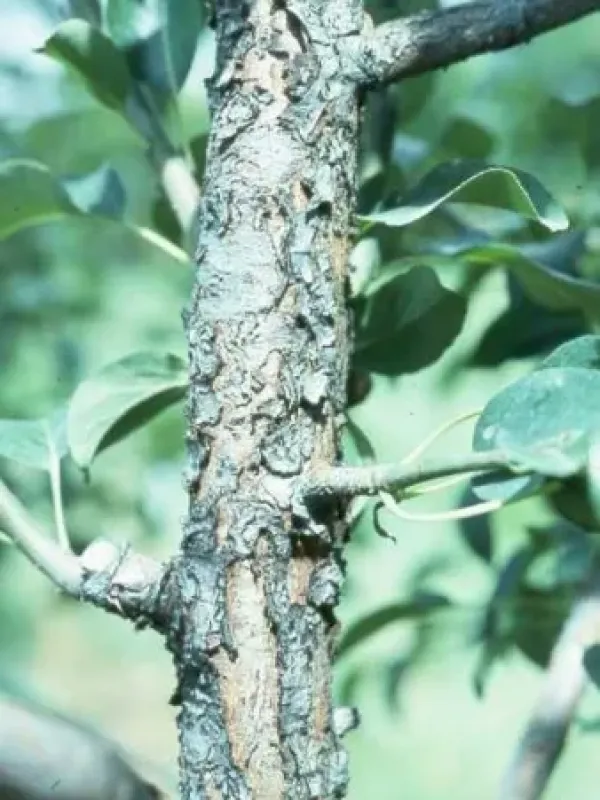
Description
Symptoms
The hallmark symptom of pear blister canker is the appearance of distinct blisters or pustules on the bark of young shoots and branches. As the infection progresses, these blisters rupture, revealing necrotic tissue underneath.
In the early stages, signs may be subtle, appearing as a slight roughness or cracking of the bark. Growers may often mistake these early symptoms for frost damage or normal bark aging.
Affected trees often show signs of leaf chlorosis, premature coloration, or leaf curling. This is caused by the systemic disruption of the tree's vascular system, preventing nutrients and water from reaching all parts of the plant.
Over time, the tree exhibits significant growth suppression. The branches may become deformed, and the tree may experience dieback of the terminal growth, which significantly lowers its overall vitality.
- Development of blisters and pustules on bark.
- Cracking and necrosis of branches.
- Leaf chlorosis and premature defoliation.
- Stunted growth and distorted branch development.
- Reduced vigor and potential tree death.
Pathogen
The causative agent of this disease is a specific viroid known as Pyrus pyrifolia-associated pear blister canker viroid (belonging to the Apscaviroid genus), technically designated as Apscaviroid pustulapyri. Unlike viruses, it consists of a single circular RNA molecule without a protein coat.
The transmission of this viroid primarily occurs through vegetative propagation. The use of infected scions or rootstocks is the most common way for the pathogen to be introduced into new orchards.
The pathogen is highly transmissible via contaminated pruning tools. If the tools are not sterilized between trees, the viroid can easily move from infected to healthy specimens within a single session.
Because viroids rely entirely on the host plant's internal cellular machinery for replication, they are deeply integrated into the tree's metabolic processes, making them extremely difficult to eliminate once established.
This pathogen is often classified as a quarantine pest in many regions due to its ability to remain latent for long periods, masking its presence until significant damage has already occurred.
Conditions for development
The most critical condition for disease outbreak is the planting of infected nursery material. Without strict certification and testing, the viroid spreads silently across new planting sites.
Environmental stress, such as extreme temperature fluctuations, drought, or poor soil management, can exacerbate the symptoms of the infection and accelerate the decline of the host plant.
The intensity of the disease is often linked to the susceptibility of the pear cultivar. Some varieties may show more aggressive symptoms, while others act as symptomless carriers, spreading the pathogen unknowingly.
Poor orchard hygiene plays a major role in the spread of the viroid. Tools that are not sanitized become vectors for the pathogen, particularly during heavy pruning seasons when many wounds are created.
The viroid’s replication is most active during the spring and summer months when the tree's metabolic activity and sap flow are at their peak, facilitating the systemic movement of the viroid within the tree.
Why it matters
The harm caused by pear blister canker is profound because it is a chronic, systemic disease. There is currently no chemical cure, and infected trees remain a permanent source of inoculum.
The disease leads to a steady decline in orchard productivity. Fruit yields drop significantly, and the fruits that are produced are often smaller, deformed, and of poor commercial quality.
Secondary infections often colonize the necrotic tissues created by the viroid blisters, leading to the rapid decay of the wood and the ultimate structural failure of the tree.
The economic impact on the grower is severe, often necessitating the complete removal and replacement of affected blocks of trees, which results in years of lost production and high replanting costs.
Because the disease is frequently latent, the pathogen can silently persist in a nursery, causing widespread infections across multiple orchards before the primary source is identified and controlled.
Protection
Prevention is the only viable strategy. It is essential to source pear trees exclusively from reputable, certified nurseries that provide virus-free and viroid-free plant material documentation.
Strict sanitation protocols must be enforced during pruning. All pruning equipment must be disinfected with alcohol or other appropriate agents between every tree to minimize the risk of mechanical transmission.
Regular visual inspections of the orchard are necessary to identify any abnormal bark conditions. If the disease is detected, prompt removal and destruction of the entire tree are recommended to prevent further spread.
Implementing modern diagnostic tools, such as molecular PCR testing, for mother trees in breeding programs is crucial to ensure that new plant stock remains free from the viroid.
Maintaining high general orchard vigor through balanced fertilization and robust pest management helps the trees better withstand the stress caused by infection, although it does not provide immunity against the viroid.
Discussion
No discussions yet — be the first.