
Apple scab
Apple leaf
Description
Symptoms
Early symptoms appear as olive-green, velvety spots on the underside of young leaves, which eventually darken and become necrotic.
As the infection progresses, affected leaves may curl, turn brown, and drop prematurely, severely reducing the tree's photosynthetic capacity.
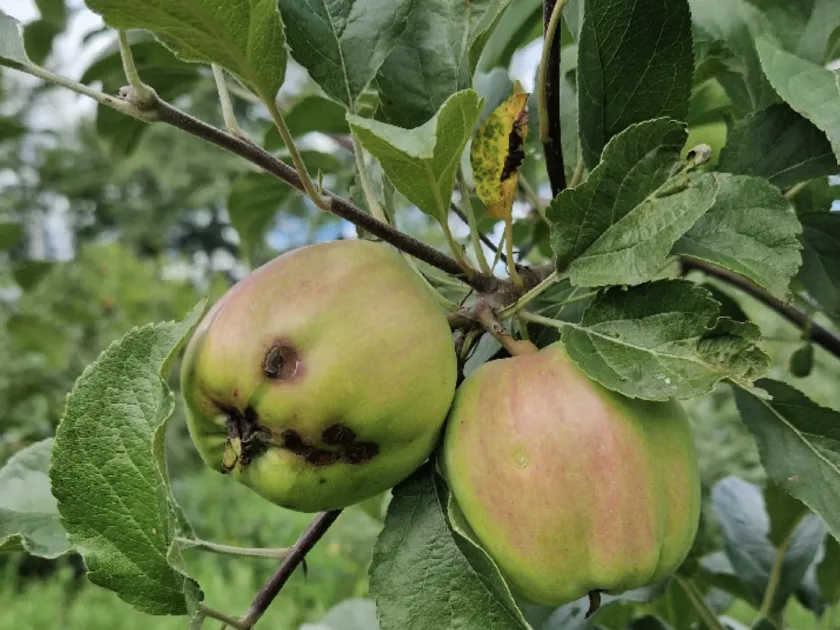
Fruit symptoms include dark, corky scabs that cause irregular growth and often result in significant disfiguration of the apples.
In severe cases, small fruitlets may drop prematurely, or larger fruits may develop deep cracks that allow secondary rot pathogens to enter.
Infections can also manifest on petioles, fruit stems, and young twigs, characterized by rough, raised lesions that can harbor the fungus over winter.
Pathogen
Apple scab is caused by the fungus Venturia inaequalis, which primarily overwinters in fallen leaves on the orchard floor.
In the spring, the fungus produces ascospores within pseudothecia, which are then discharged into the air during rain events to infect young leaves and blossoms.
After the initial infection, the fungus produces conidia, which serve as secondary inoculum, spreading the disease throughout the canopy during the growing season.
The pathogen thrives by colonizing the leaf cuticle and fruit epidermis, extracting nutrients and causing visible lesions on the plant tissue.
The biological lifecycle of the fungus is highly dependent on humidity levels, allowing it to complete multiple infection cycles in a single year.
Conditions for development
The development of apple scab is heavily influenced by the duration of leaf wetness and the ambient temperature following an infection event.
Prolonged spring rains provide ideal conditions for the primary ascospore release, which coincides with the critical early growth stages of the apple tree.
Orchards with poor air circulation, often due to high planting density or lack of pruning, are at a significantly higher risk of severe scab outbreaks.
Temperature plays a crucial role; the disease develops rapidly when temperatures stay between 15 and 20 degrees Celsius with constant moisture.
Even in seasons with lower average temperatures, the fungus can still infect trees as long as the periods of moisture are sufficiently long.
Why it matters
The primary economic impact of apple scab is the loss of fruit marketability due to unsightly lesions and deformation, making them unfit for sale.
Defoliation caused by the fungus weakens the trees, leading to lower fruit yields in subsequent years and poor overall growth performance.
Trees affected by chronic scab are less winter-hardy and more susceptible to environmental stressors, increasing the risk of branch dieback.
The financial burden of controlling the disease requires multiple fungicide applications, which increases production costs significantly.
Secondary infections often take advantage of the structural damage caused by scab lesions, leading to further storage losses after harvest.
Protection
Sanitation is the cornerstone of control; raking and composting or burning fallen leaves significantly reduces the overwintering inoculum in the orchard.
Pruning is essential to open up the canopy, promoting airflow and rapid drying of foliage, which inhibits the conditions necessary for fungal spores to germinate.
Preventative fungicide sprays are standard practice, with applications timed precisely according to the tree's growth stages and local weather forecasts.
Integrated Pest Management (IPM) strategies, including the use of disease-resistant apple cultivars, can significantly reduce the need for chemical intervention.
- Planting resistant apple varieties to minimize disease pressure.
- Implementing regular orchard hygiene to remove infected plant debris.
- Monitoring weather patterns to predict and prevent primary infection periods.
Discussion
No discussions yet — be the first.