
Grapevine leafroll disease
Ampelovirus trivitis
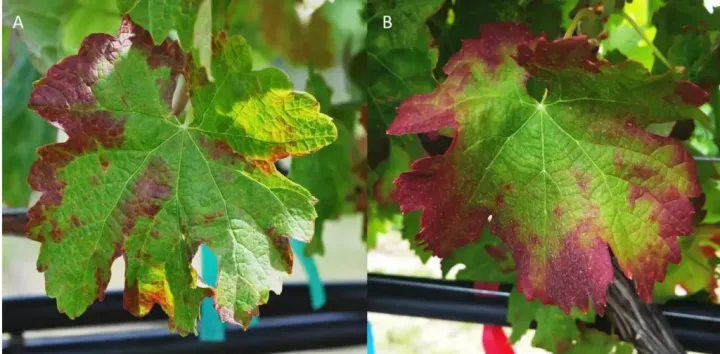
Description
Symptoms
Symptoms typically appear in late summer and are most noticeable on the older, lower leaves of the vine.
The characteristic sign is the downward rolling of leaf margins, often accompanied by the thickening of the leaf blade.
Leaves on red grape varieties exhibit interveinal reddening, while white varieties show chlorosis, leaving the veins green.
Vine growth is stunted, and the internodes become shortened, leading to an overall reduction in the vine's vigor.
Fruit set is often poor, and the grapes exhibit delayed ripening and significantly lower sugar content compared to healthy vines.
Pathogen
The disease is caused by a complex of viruses within the genus Ampelovirus (family Closteroviridae).
These viruses are phloem-limited, meaning they interfere with the plant's vascular system, disrupting the translocation of sugars.
The most common forms, such as GLRaV-3, are transmitted primarily through infected vegetative propagation material.
Various species of mealybugs and scale insects act as natural vectors, spreading the virus from vine to vine.
The infection is persistent and systemic; once a vine is infected, it remains a source of inoculum for the rest of its life.
Conditions for development
The spread of the virus is closely tied to the population dynamics of its insect vectors, such as mealybugs.
Warmer climates support higher vector populations, increasing the speed at which the virus moves through a vineyard.
Inappropriate sanitation practices during pruning and harvesting can lead to mechanical transfer of the virus if insects are present.
The use of uncertified rootstocks and scion wood remains the primary driver of long-distance virus dispersal.
High-density plantings may accelerate the localized spread of vectors between neighboring vines, worsening the infection rate.
Why it matters
The primary economic impact is a drastic reduction in grape quality, particularly sugar accumulation and anthocyanin development.
Winemakers face significant challenges as fruit from infected vines lacks the necessary balance for high-quality production.
Reduced vine vigor leads to long-term decline and lower yield year after year, eventually rendering the vineyard unprofitable.
Infected vines show increased susceptibility to cold stress, winter injury, and other secondary fungal diseases.
The persistent nature of the disease requires costly vineyard replacement programs to restore productivity.
Protection
Strict use of certified, virus-tested nursery stock is the foundation of any effective prevention strategy.
Integrated Pest Management (IPM) focused on controlling mealybugs and scale insects is essential to slow the spread.
Rogueing, the systematic removal and destruction of infected vines, is necessary to reduce the reservoir of the virus.
Thorough sanitization of pruning shears and other tools between blocks helps prevent the spread of vectors and potential viral transfer.
Establishing isolation zones around new plantings can help protect them from neighboring infected blocks.
Discussion
No discussions yet — be the first.