
Strawberry crinkle
Alphacytorhabdovirus fragariarugosus
Description
Symptoms
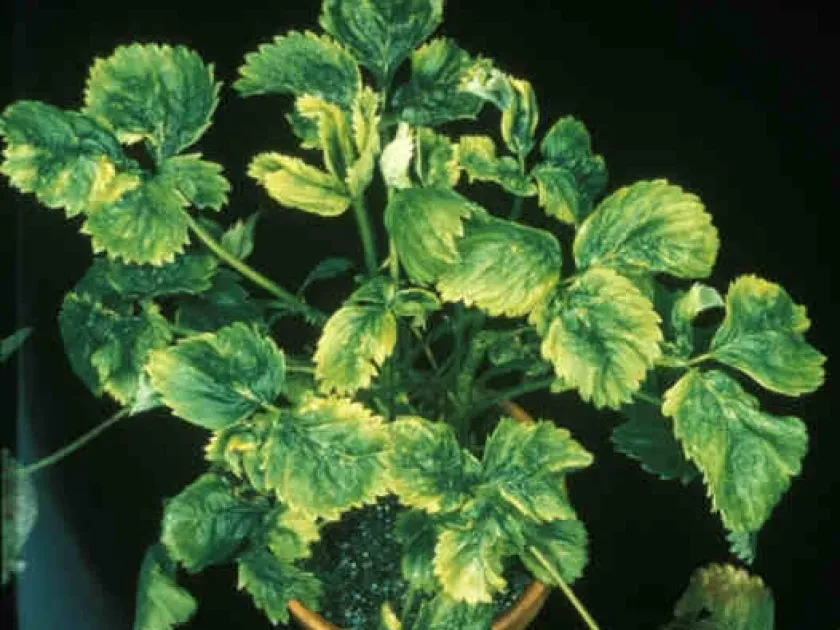
The key symptom is a characteristic deformation of the leaves, which become crinkled, puckered, and lose their natural symmetry. The leaves often appear gnarled or twisted.
Chlorotic spots are clearly visible on the surface of the leaves. These spots can be small or coalesce into larger necrotic areas where the tissue loses its normal green coloration.
Affected plants show stunted growth. The strawberry bushes become dwarfed, and the leaf petioles shorten, giving the entire plant a rosette-like appearance.
During flowering and fruiting, symptoms become more pronounced. Yields are significantly reduced, and the berries are often small, malformed, and unsuitable for fresh market sale.
- significant reduction in leaf blade size;
- presence of chlorotic stippling and necrosis;
- reduction in photosynthetic efficiency;
- withering of generative organs and flowers.
Pathogen
The causative agent of the disease is the strawberry crinkle virus, scientifically classified as Alphacytorhabdovirus fragariarugosus. This is a severe systemic viral infection that affects all parts of the strawberry plant.
The virus belongs to the Rhabdoviridae family. A crucial biological feature is that it is not transmitted mechanically through sap or by using garden tools during pruning.
The primary vector for the virus in natural environments is the strawberry aphid, Chaetosiphon fragaefolii. The insect acquires the virus while feeding on infected strawberry plants.
The virus can persist in planting material, which makes vegetative propagation the main way it spreads to new areas. Often, the infection remains latent in the plant for long periods.
The disease is chronic in nature. Once a plant is infected, the pathogen persists for the rest of the plant's life, steadily depleting its vital resources and growth potential.
Conditions for development
The spread of the virus is directly linked to the lifecycle of its vector, the strawberry aphid. High activity of these insects typically occurs during warm, dry weather in spring.
The density of the aphid population determines the rate of virus spread across a field. High pest numbers facilitate rapid transmission of the virus to healthy plants.
While high humidity does not affect the virus itself, it indirectly supports the development of large insect populations, creating an environment favorable for the disease's expansion.
Poor agricultural practices, such as overcrowding of plants, exacerbate the spread. In dense plantings, aphids can easily migrate between neighboring strawberry bushes.
The migration of winged aphid forms during the summer leads to infection over long distances, making it difficult to maintain spatial isolation of the fields.
Why it matters
The primary damage is the complete loss of product marketability. Berries lose their flavor and aroma and are frequently misshapen, rendering them unsuitable for retail.
Severe infection leads to the premature death of the strawberry bushes. Infected plants have a shortened lifespan and often collapse within two to three years of planting.
The virus weakens the plant's overall immune system. Consequently, the bushes become highly susceptible to secondary fungal infections, such as leaf spot or powdery mildew.
Economic losses include the inability to use the infected field as a source of disease-free propagation material, leading to massive financial setbacks for nursery operators.
Total losses incorporate costs for early removal of infected fields, purchasing new certified virus-free material, and constant chemical management of aphid populations.
Protection
The primary protection measure is to use only high-quality, certified virus-free planting material derived from tissue culture or reliable professional nurseries.
Systematic control of the strawberry aphid is essential. Applying systemic and contact insecticides during peak pest activity significantly reduces the risk of virus transmission.
Maintaining proper spatial isolation between new, clean plantings and old, potentially infected fields is critical for the long-term success of strawberry production.
If symptoms of crinkle are detected, infected plants should be immediately rogued out and destroyed along with their root systems to prevent local spread.
Regular monitoring of field health allows for the early detection of infection foci, enabling growers to localize the virus and prevent a total field outbreak.
Discussion
No discussions yet — be the first.