
Garlic filamentous virus
Allexivirus filumallii
Description
Symptoms
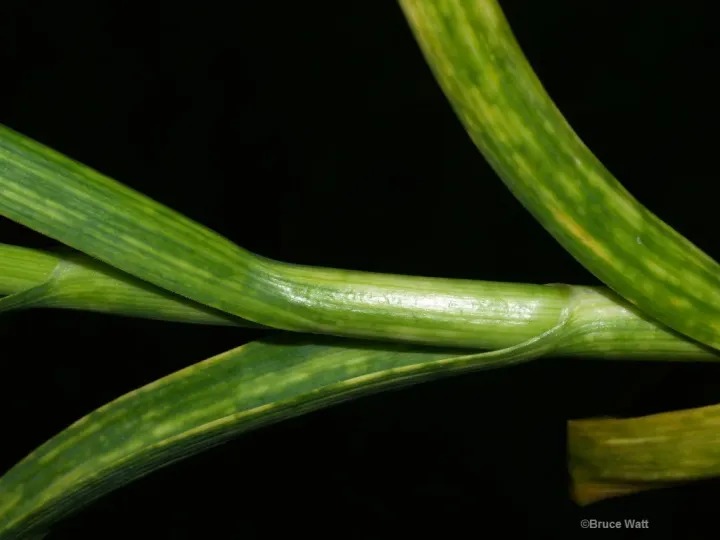
The main sign of infection is the characteristic deformation of the leaf blade: leaves become narrow, filamentous, acquire a chlorotic color, and often twist.
A mosaic pattern, alternating with light stripes or spots, is observed on the leaf surface, indicating a disruption of photosynthesis in the plant tissues.
Severely affected plants lag significantly behind healthy ones in growth and development; their aerial parts appear stunted and yellow prematurely.
Infected plants show underdeveloped root systems, which directly impacts the quality of the underground part of the crop.
Bulbs from infected plants become small, soft, and have poor shelf life, making them unsuitable for market or long-term storage.
Pathogen
The causative agent of the disease is the garlic filamentous virus, belonging to the genus Allexivirus (family Betaflexiviridae). These are small filamentous viruses containing single-stranded RNA.
Viral particles have a specific morphology and are transmitted primarily via vegetative propagation through infected planting material, making the issue highly relevant for commercial production.
The main natural vector of virus transmission in field conditions is the garlic mite (Aceria tulipae), which transfers viral particles from infected plants to healthy ones while feeding.
In addition to mites, the virus spreads mechanically through contact with damaged tissues, the use of shared pruning tools, or during mass leaf damage caused by insects.
This pathogen is rarely found in isolation; it is more often part of a viral complex that causes the degradation of garlic and onion varieties when grown in the same plot for many years.
Conditions for development
The primary condition for the mass spread of the disease is the use of infected seed material, in which the virus accumulates year after year.
High populations of garlic mites during warm and dry weather create a critical risk for the rapid spread of the virus throughout the plantation.
Failure to rotate crops and returning garlic to the same plot earlier than 3–4 years promotes the survival of the infection source in the soil via plant residues.
The use of non-sterilized tools during crop maintenance and garlic harvesting is a factor that accelerates the epiphytotic development of the disease.
Poor agricultural practices and weakening of plants by environmental stress factors make them more susceptible to systemic viral infections.
Why it matters
Garlic filamentous virus causes serious economic damage, reducing marketable yields by 30–50% or more, depending on the variety.
Due to pathological changes in tissues, bulbs dry out, rot, or sprout prematurely, leading to significant losses during storage and transportation.
The continuous accumulation of the virus in planting material leads to "variety degeneration," where productivity falls to critical levels, making cultivation unprofitable.
Infected plants become extremely vulnerable to secondary fungal and bacterial infections that attack the root system and the basal plate of the garlic.
The problem is exacerbated by the lack of direct chemical control agents (virucides), classifying this disease as a difficult-to-manage pathology.
Protection
The key protection method is the use of certified virus-free planting material, obtained through clonal micropropagation techniques.
Regular phytosanitary weeding of crops: upon identifying the first signs of filamentation, affected plants must be immediately removed from the field and destroyed.
Strict control of vector pest populations, primarily the garlic mite, using authorized acaricides during periods of peak activity.
Disinfection of garden tools (pruners, knives) using alcohol or other specialized solutions after every pass through the field.
Adherence to crop rotation rules and spatial isolation of garlic plots from other onion crops to prevent the migration of the virus.
Discussion
No discussions yet — be the first.