
Shallot latent virus
Allexivirus ecsascalonicum
Description
Symptoms
As the name suggests, the virus is often latent, showing little to no external symptoms in many cultivars. This "hidden" presence is a significant threat because infected plants can continue to spread the virus unknowingly.
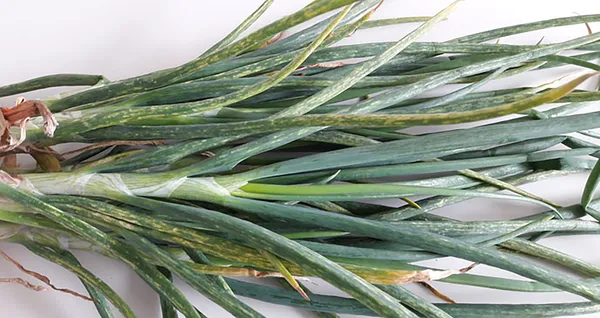
When symptoms do manifest, they typically present as mild mosaic patterns or chlorotic streaks on the leaves. Leaves may also show slight twisting, deformation, or stunted growth compared to healthy plants.
In cases of severe infection or mixed viral complexes, the entire plant may appear yellowed and lose vigor. The reduced photosynthetic surface area leads to a decrease in the overall plant development and biomass.
The bulbs themselves may not show significant visual changes, but they often lack the firmness or typical morphological characteristics of healthy stock. This makes visual selection of healthy bulbs during harvesting unreliable.
Definitive identification of the infection requires specialized laboratory diagnostics. Techniques such as Enzyme-Linked Immunosorbent Assay (ELISA) or Reverse Transcription Polymerase Chain Reaction (RT-PCR) are essential for confirming the presence of the virus.
Pathogen
Shallot latent virus (Allexivirus ecsascalonicum) is a plant virus belonging to the genus Allexivirus. It is a filamentous virus that is primarily transmitted through vegetative propagation of infected bulbous crops.
The pathogen is an obligate parasite, meaning it requires living host tissue to replicate and spread. It is known for its ability to persist in plant cells without causing immediate, drastic changes, often remaining latent for long periods.
The virus particles consist of a single-stranded RNA genome protected by a protein coat. Its biological cycle is deeply integrated with the host's cellular machinery, making it systemic, meaning it infects the entire plant.
Transmission occurs predominantly through the use of infected sets or bulbs for planting. Additionally, mite vectors are capable of spreading the virus from plant to plant during the growing season by feeding on infected sap.
It is often found in coinfection with other onion-infecting viruses. This complex infection pattern can make it challenging for agronomists to determine the specific role of the latent virus in the overall decline of crop health.
Why it matters
The primary agricultural impact of Shallot latent virus is the reduction in yield. Because the infection affects the metabolic processes of the plant, bulbs remain smaller and weigh significantly less than they should.
Market quality is also compromised. Infected bulbs often have poor storage characteristics, leading to higher rates of decay and shrinkage while in storage, which results in significant post-harvest economic losses.
The virus suppresses the plant's natural immune response. Consequently, infected crops become highly susceptible to secondary pathogens, including various species of fungi and bacteria that cause root and bulb rots.
On a farm scale, the accumulation of the virus in vegetative material leads to the degeneration of high-yielding varieties over time. Without proper intervention, entire batches of planting material can become useless.
Managing the virus increases production costs due to the need for continuous testing, specialized seed sourcing, and rigorous pest control programs to minimize the spread of vectors within the field.
Protection
The cornerstone of managing Shallot latent virus is the use of virus-free planting material. Farmers should source their sets from reputable producers who employ meristem culture and rigorous testing to ensure health.
Regular monitoring of fields is essential. Any plants exhibiting suspicious signs, such as abnormal yellowing or leaf curling, must be immediately rogued out and destroyed to prevent the virus from spreading further.
Integrated Pest Management (IPM) is crucial to control vectors such as mites and aphids. By reducing the population of these insects through timely application of acaricides and insecticides, the risk of viral transmission is significantly lowered.
Sanitation practices should be strictly enforced. Tools, knives, and machinery used for trimming or processing bulbs must be disinfected frequently using appropriate chemical solutions to avoid mechanical transmission between plants.
Practicing long crop rotations helps to keep the soil and local environment clear of potential viral reservoirs. Providing a break between onion plantings reduces the carry-over risk and helps maintain long-term soil productivity.
Discussion
No discussions yet — be the first.