
Aleurodiscus phragmitis
Aleurodiscus phragmitis
Description
Symptoms
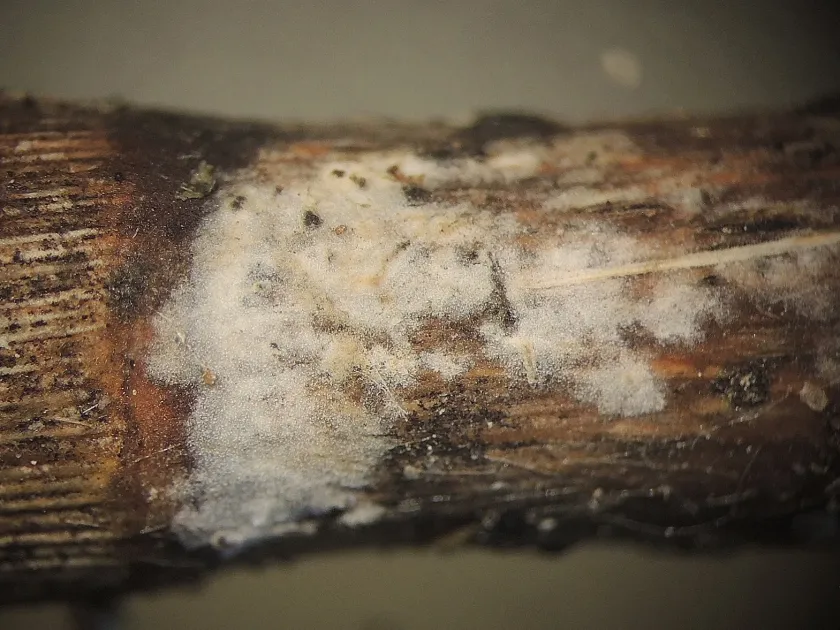
The primary symptom of Aleurodiscus phragmitis is the development of crust-like or leathery fruiting bodies directly on the stems of the reed plants.
These fungal growths often appear as pale, whitish, or cream-colored patches that may merge to cover significant portions of the reed stem surface.
Infected areas are most commonly found near the base of the stems, where moisture levels remain high throughout the growing season.
As the fungus matures and begins sporulation, the texture of these patches becomes slightly rougher, making them visible to the naked eye upon close inspection.
The host tissue underneath the fungal growth may show signs of degradation, losing its structural integrity and becoming increasingly fragile or brittle over time.
Pathogen
The causative agent is the basidiomycete fungus Aleurodiscus phragmitis, which is specialized to inhabit stems of hydrophilous grasses.
This fungus primarily acts as a saprotroph, decomposing dead organic matter, but can behave as a weak parasite on stems weakened by environmental stressors.
The pathogen reproduces via basidiospores, which are dispersed efficiently by wind currents across the wetland or reed bed environment.
The mycelium of the fungus is capable of persisting in plant debris for extended periods, serving as a constant source of infection in favorable conditions.
Aleurodiscus phragmitis is adapted to the specific microclimate of reed beds, allowing it to thrive in environments where other fungi might struggle.
Conditions for development
High relative humidity is the most critical factor for the growth and colonization of Aleurodiscus phragmitis within the reed community.
The fungus thrives in moderate temperature ranges, typically showing peak activity during the cool, damp periods of the spring and autumn months.
Dense reed stands with poor air circulation create stagnant microclimates that promote the development of the fungal colonies on the stems.
Accumulation of dead vegetation from previous seasons provides the necessary substrate for the initial establishment of the pathogen.
Limited sunlight penetration into the lower stem canopy prevents the surface from drying out, further facilitating the rapid spread of the fungus.
Why it matters
The primary damage caused by Aleurodiscus phragmitis is the accelerated breakdown of reed stems, which reduces the quality of the material for industrial use.
Affected stems lose their mechanical strength, making the reed beds more susceptible to lodging and physical damage from heavy wind or rainfall.
While usually not lethal, the infection can weaken the overall vitality of the reed population, especially in stressed or nutrient-deficient environments.
In landscape management, the aesthetic quality of the reed bed is compromised when visible fungal plaques cover the stems, leading to an untidy appearance.
Commercial harvesting of reeds is hindered because the infection necessitates rigorous sorting to remove compromised stems, increasing labor costs.
Protection
Sanitation is the most effective management strategy; removing and destroying old reed debris helps significantly reduce the primary inoculum load.
Thinning out dense reed stands improves ventilation and light penetration, effectively lowering the humidity levels around the base of the plants.
Proper water management in wetlands can help prevent prolonged saturation of the soil, which in turn reduces the humidity favorable to the fungus.
Regular harvesting of mature reeds ensures that old, susceptible stems are removed before they become heavily colonized by the pathogen.
Although chemical control is rarely justified, fostering a healthy ecosystem with biological diversity can help suppress the proliferation of such fungal pathogens.
Discussion
No discussions yet — be the first.