
Yellow-staining mushroom
Agaricus placomyces
Description
Symptoms
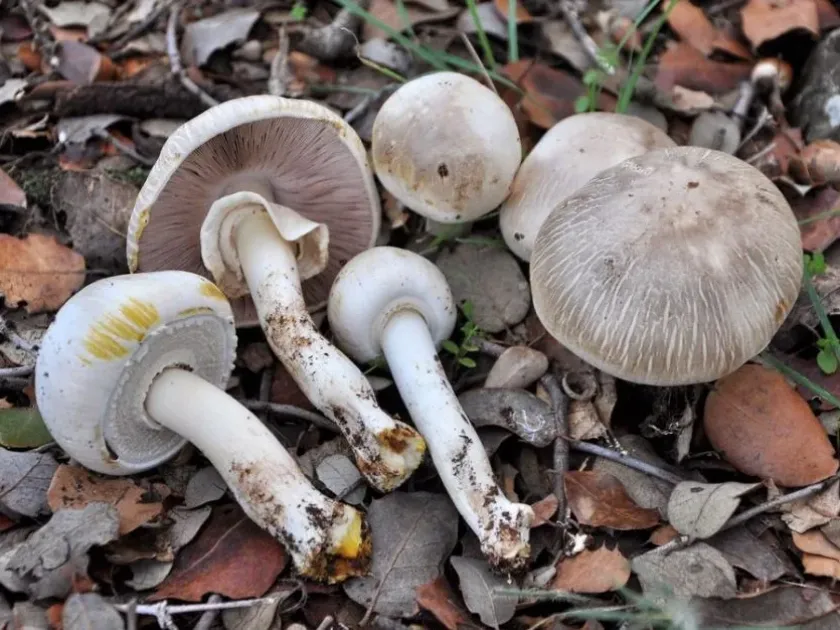
The yellow-staining mushroom (Agaricus placomyces) is a toxic gilled fungus that is frequently mistaken for edible species of the Agaricus genus.
Its primary visual feature is a whitish or grayish cap with a distinct, dark, nearly black scaly patch in the center, which becomes very prominent in mature specimens.
When the flesh is bruised or sliced, it exhibits a characteristic, rapid chemical reaction, turning a vivid and intense yellow color, particularly at the base of the stem.
Another crucial identification feature is the unpleasant odor of phenol or chemical antiseptic, which becomes much more intense when the mushrooms are cooked.
The gills of young specimens are pale pink, maturing to dark chocolate brown, while the stem features a wide ring that also yellows upon contact.
Pathogen
The yellow-staining mushroom is a saprotrophic fungus belonging to the Basidiomycota division, living on organic matter rather than attacking living plants.
While it is not a crop pathogen, it is a common inhabitant of gardens, lawns, and areas adjacent to agricultural lands, where it decomposes soil organic matter.
The fungal mycelium spreads throughout the top layer of soil or leaf litter, effectively breaking down complex organic compounds and recycling nutrients.
Its biological cycle involves the production of fruit bodies from summer to autumn, provided the environmental conditions meet its requirements for moisture and nutrients.
Spores are dispersed by wind currents, enabling the mushroom to colonize various habitats ranging from urban parks to rural landscapes rich in decaying vegetation.
Conditions for development
This species thrives in nutrient-rich soils, often appearing on well-fertilized lawns, in orchards, and near tree lines where organic matter accumulates.
Warm temperatures accompanied by high humidity are the primary drivers for the rapid development of its fruiting bodies during the mid-to-late summer months.
Agaricus placomyces demonstrates significant adaptability, flourishing in both sun-drenched, open areas and shaded environments under dense foliage.
Agricultural practices that involve heavy nitrogen fertilization can inadvertently create ideal conditions for the colonization and spread of this mushroom on farm premises.
The presence of well-established humus layers and adequate soil moisture are essential factors that promote the health and productivity of the fungal colony.
Why it matters
The primary hazard of the yellow-staining mushroom is its toxicity to humans, as consumption leads to severe gastrointestinal distress and painful illness.
Symptoms typically manifest shortly after consumption and include nausea, forceful vomiting, abdominal cramps, and persistent diarrhea, requiring medical attention.
The toxins responsible for the poisoning are heat-stable and are not destroyed by boiling, frying, or any standard culinary preparation method.
The confusion with popular edible mushrooms is the main cause of accidental poisoning, making it a significant safety concern for amateur mushroom pickers.
Although it does not damage crops, its presence in large numbers can be a nuisance on lawns and near farm buildings, necessitating manual control measures.
Protection
The most effective strategy for safety is public education, emphasizing the importance of the yellow-staining reaction and the phenol odor test for identification.
On private lands or commercial farm grounds, the accumulation of decaying organic material should be managed to reduce suitable substrates for the fungus.
When fruiting bodies are found in undesired areas, they should be carefully removed, including the base of the stem, to prevent further spore dispersal.
Strict adherence to the "if in doubt, throw it out" policy is crucial for anyone foraging for wild mushrooms to prevent accidental poisoning from Agaricus placomyces.
Management staff in agricultural settings should be trained to recognize and eliminate these mushrooms from production areas to ensure safety for all workers.
Discussion
No discussions yet — be the first.