
Hungarian clover
Trifolium pannonicum Jacq.
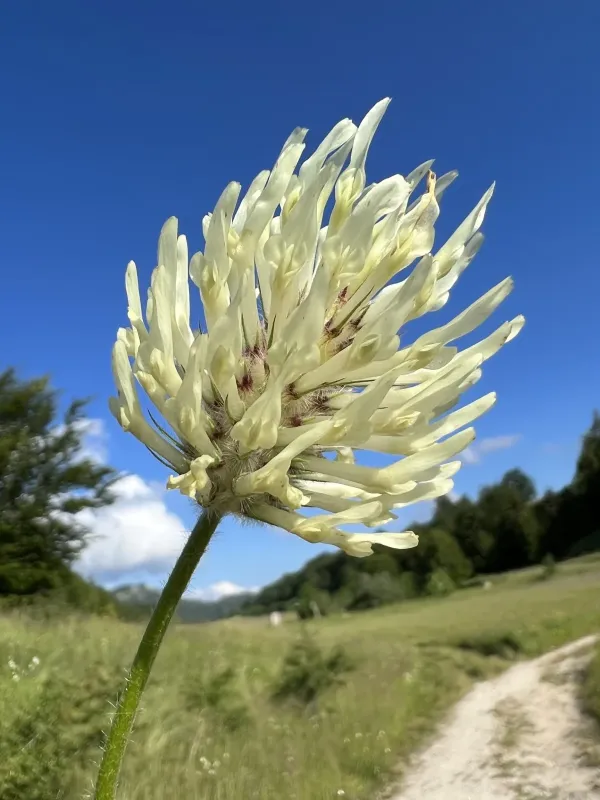
Description
Sowing dates
Hungarian clover (Trifolium pannonicum) is a long-lived perennial legume prized for its robustness and ability to thrive in diverse environmental conditions.
The optimal sowing time is early spring, which allows the crop to utilize soil moisture effectively, ensuring a strong start and uniform establishment.
Seeds should be placed at a depth of 1 to 2 centimeters; this depth ensures optimal seed-to-soil contact while allowing the seedling to emerge efficiently.
Maintaining an appropriate seeding rate is essential to establish a dense stand, which helps suppress weed growth and increases overall fodder quality.
As the crop is somewhat slow to establish during the first year, providing weed control during the seedling stage is critical for successful field development.
Growing requirements
Originating from Southeastern Europe, Hungarian clover is remarkably drought-tolerant, outperforming many other clover species in regions with limited rainfall.
The plant prefers neutral to slightly alkaline soils and thrives in well-drained conditions, as it is sensitive to waterlogging and soil saturation.
It is a light-demanding species that excels in sunny locations; excessive shade from surrounding trees or bushes can significantly reduce its biomass production.
The soil structure should be conducive to deep root growth, as the plant develops a substantial root system that provides stability and access to moisture.
Adequate levels of phosphorus and potassium in the soil significantly benefit root development and increase the persistence of the clover in the field.
Yield
The primary use of Hungarian clover is as a high-quality forage source for livestock, providing excellent protein content and essential minerals in hay form.
The crop shows good regrowth potential, allowing for multiple cuttings per season, provided that environmental conditions and moisture levels are favorable.
Due to its high persistence, it is an ideal candidate for long-term pastures and meadows, maintaining productivity for several years without the need for reseeding.
Yields are maximized when the crop is harvested during the early flowering phase, which strikes a balance between total biomass and nutritional density.
Beyond forage production, this clover contributes to soil health by fixing atmospheric nitrogen, serving as a beneficial component in crop rotation systems.
Main diseases and pests
Like other legumes, Hungarian clover can be susceptible to fungal diseases such as powdery mildew, especially during periods of high humidity and stagnant air.
Common pests include clover weevils and various aphid species, which can cause significant damage to the foliage and affect the overall yield of the green mass.
Integrated pest management strategies, including proper crop rotation and the maintenance of vigorous stands, are the most effective ways to minimize damage.
Thinning stands can create favorable microclimates for pests and pathogens, making proper management of the stand density a preventative measure.
When chemical interventions are necessary, they should be applied judiciously, ensuring compliance with local safety regulations regarding harvest intervals.
Harvesting
Harvesting is best conducted at the onset of the flowering stage, when the nutritional value, particularly protein and soluble sugars, is at its peak.
Proper drying techniques are essential; excessive handling of the dried hay can lead to leaf shatter, causing a significant loss of nutrients from the foliage.
Mechanical harvesting should be carried out carefully to preserve the structural integrity of the plant and ensure the hay remains free of moisture-induced spoilage.
If harvested for seed, timing is crucial; the operation should occur once the majority of flower heads have matured to minimize yield losses from shattering.
A well-executed harvest results in a premium fodder product that supports livestock health and weight gain during the winter feeding season.