
Fowl bluegrass
Poa palustris L.
Description
Sowing dates
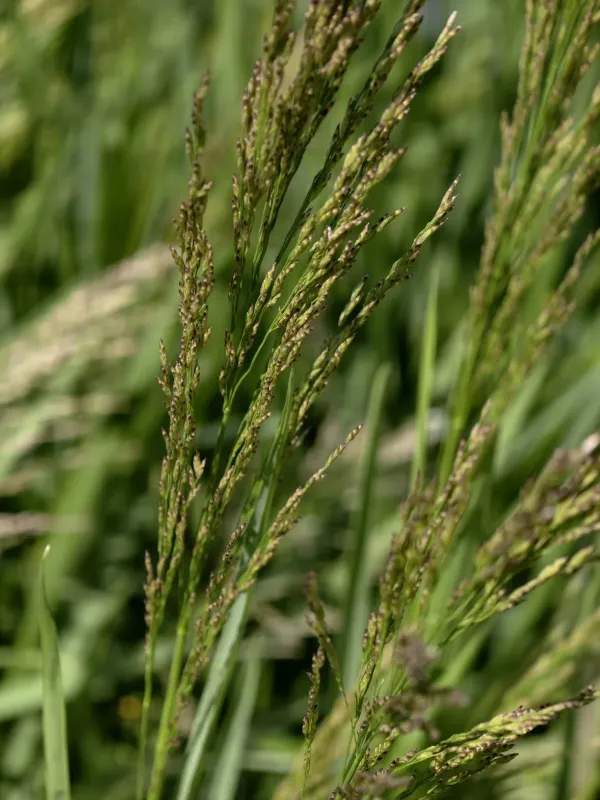
Fowl bluegrass (Poa palustris L.) belongs to the Poaceae family. It is a valuable perennial forage crop, most commonly utilized in seed mixtures for establishing highly productive meadows and hayfields in moist or poorly drained environments.
The optimal sowing time is early spring, as soon as the soil reaches physical maturity. In regions with milder climates, late-autumn sowing is permissible, allowing seeds to undergo natural stratification and emerge uniformly as soon as snow melts.
The seeding rate depends on seed purity and the intended use of the stand. For pure stands or specialized hay mixtures, a rate of 8 to 12 kg per hectare is recommended when using traditional row-drilling methods.
To ensure even seed distribution on light soils, rolling the field after sowing is recommended. The seeds are small and require shallow planting depth, ideally between 1 and 2 cm, to maintain optimal contact with the moist soil surface.
Because the crop exhibits slow initial growth during its first year, preventing competition from weeds is essential. Timely mowing of unwanted vegetation during the tillering phase of Fowl bluegrass significantly improves stand establishment.
Growing requirements
This crop is a true hydrophyte, making soil moisture the primary requirement for success. Fowl bluegrass tolerates prolonged flooding by spring runoff (up to 30–45 days), making it an ideal choice for riparian or floodplain agricultural land.
It prefers fertile loam and peat-bog soils with a neutral or slightly acidic pH. The plant responds well to mineral fertilizers, particularly nitrogen, which stimulates vigorous vegetative biomass production during the growth season.
The plant is highly winter-hardy and capable of surviving significant temperature fluctuations. Its natural range encompasses forest and forest-steppe zones, where it has successfully adapted to temperate climatic conditions.
Light exposure plays a crucial role in generative shoot development, yet Fowl bluegrass demonstrates satisfactory productivity even under partial shade, allowing its use in agroforestry systems and woodland buffers.
Strong competition against other grass species allows Fowl bluegrass to maintain a dominant position in the sward for 5 to 8 years, provided that proper grazing or haying management is maintained.
Yield
The fresh biomass yield of Fowl bluegrass under favorable conditions can reach 15 to 25 metric tons per hectare. These figures depend significantly on soil fertility levels and moisture availability during periods of peak growth.
When harvested for hay, the dry matter yield typically ranges from 4 to 7 metric tons per hectare. The hay quality is rated as high; it is known for its softness, excellent palatability, and a balanced protein content suitable for various livestock.
Maximum productivity is typically observed in the second and third years after establishment, when the stand reaches its peak tillering stage. Timely application of phosphorus and potassium fertilizers helps sustain high yields over multiple years.
Seed production averages 200 to 400 kg per hectare. Harvesting should occur at full maturity, when the panicles turn a characteristic straw-yellow color, with care taken to prevent seed shattering during the cutting process.
To maintain consistent yields, periodic rejuvenation of the stand via overseeding or the application of organic fertilizers during the autumn period is recommended.
Main diseases and pests
The primary threats to this crop include fungal diseases, such as rust and powdery mildew, which thrive in high-humidity conditions and overly dense, poorly ventilated stands.
Among pests, cereal flies and aphids can cause significant damage by affecting leaves and stems during the shooting phase. Additionally, wireworms may damage the root system if the crop is established on recently converted virgin lands.
Effective disease management includes preventive measures such as adhering to recommended seeding rates, preventing excessive density, and timely harvesting. In cases of critical infection, authorized fungicides may be applied.
Pests often migrate from adjacent fields, making phytosanitary monitoring of field edges essential. Insecticide treatments should only be performed during periods of mass infestation prior to the onset of flowering.
While the biological resistance of Fowl bluegrass to pathogens is moderate, proper agronomic practices allow producers to minimize yield losses to economically insignificant levels.
Harvesting
Harvesting Fowl bluegrass for hay is best conducted at the panicle emergence stage, before flowering begins. This period ensures the optimal balance between biomass volume and overall nutritional value.
When using the pasture for grazing, rotational management is vital, as the crop is sensitive to excessive trampling during periods of soil saturation. A residual stubble height of at least 5–7 cm should be maintained.
To ensure high-quality feed, the cut material should be cured in windrows until moisture levels reach 15–18%. This practice prevents nutrient loss and mold development, ensuring reliable preservation for winter feeding.
Regrowth after mowing is quite rapid, allowing for two to three cuts per season under conditions of adequate moisture and post-harvest fertilization.
Fowl bluegrass hay is valued in livestock production as a nutritious component of rations for cattle, contributing to steady weight gain and high milk productivity in dairy herds.