
Korean angelica
Angelica koreana Max.
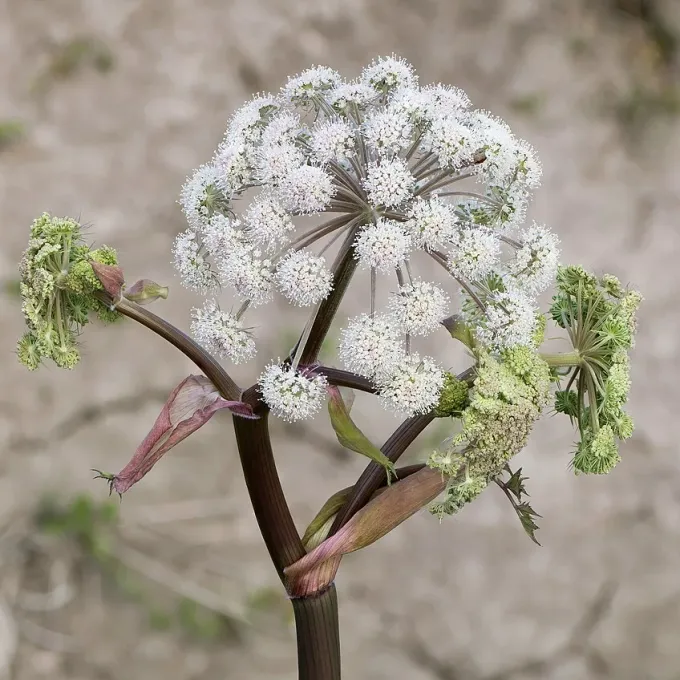
Description
Sowing dates
Sowing Korean angelica (Angelica koreana Max.) is typically performed in late autumn or early spring after the seeds have undergone a necessary stratification period. The optimal timing for open-field planting is October, allowing seeds to experience natural cold exposure throughout the winter months.
Seeds are sown in rows with a spacing of approximately 45–60 centimeters between them to ensure adequate space for plant development. The planting depth should be kept shallow, between 1 to 2 centimeters, as the seeds are small and require consistent contact with soil moisture to germinate effectively.
Germination of this species is relatively slow, making weed control in the initial stages of vegetation critical for success. Early sowing enables the plants to establish a strong root system before the onset of intense summer heat.
To ensure uniform emergence and speed up the germination process, artificial stratification in a cool environment for 30–45 days can be utilized. This approach is highly recommended for commercial-scale cultivation to achieve consistent stand density.
During spring sowing, maintaining constant moisture in the topsoil is essential to prevent embryo desiccation. Applying a light layer of organic mulch can help retain moisture and facilitate the emergence of delicate angelica seedlings.
Growing requirements
Korean angelica belongs to the Apiaceae family and thrives in moderately moist, fertile soils. Deep loam soils rich in organic matter and possessing a neutral pH balance are ideal for achieving maximum root development and biomass.
The plant performs best in sunny locations, although it can tolerate light partial shade during the hottest parts of the day in warmer climates. Essential agronomic practices include regular irrigation, particularly during dry spells, as moisture stress significantly impacts root weight.
Adequate soil drainage is a fundamental requirement, as waterlogging can lead to root rot and poor crop health. The plant is highly responsive to applications of potassium and phosphorus fertilizers, which assist in the synthesis of essential secondary metabolites.
Biologically, it is typically a biennial or short-lived perennial herb characterized by a strong, deep taproot. During the first year, it develops a large basal rosette, while in the second year, it produces a robust flowering stem reaching heights of 1 to 1.5 meters.
The native range covers the Korean Peninsula, Japan, and northeastern China. Its adaptation to temperate climates with distinct seasonality makes it a suitable candidate for introduction in similar regions worldwide that share these specific environmental conditions.
Yield
The primary agricultural objective for Korean angelica is the production of medicinal-grade root material. A single mature plant can yield between 200 and 400 grams of dried root material under optimized growth conditions.
Average yields in professional cultivation settings typically range from 15 to 25 centners per hectare. This variation depends heavily on adherence to proper agronomic practices, soil quality, and the timing of the harvesting operations.
The concentration of beneficial essential oils and coumarins in the roots varies significantly based on plant age and the time of harvest. Maximum bioactive content is usually achieved at the end of the first year or the beginning of the second year of growth.
Maintaining proper spacing and conducting regular inter-row cultivation are vital factors for improving final yield parameters. Overcrowding should be strictly avoided to ensure that each individual plant has sufficient resources to develop a high-quality root.
Economic viability is driven by strong international demand in the pharmaceutical and cosmetic industries. Implementing rigorous post-harvest drying techniques at controlled low temperatures is necessary to preserve the plant's valuable medicinal properties.
Main diseases and pests
The crop is susceptible to fungal diseases such as powdery mildew, which can become problematic in conditions of high humidity and poor ventilation. Preventive measures include proper crop spacing and ensuring good airflow across the production field.
Common pests include aphids and soil-borne nematodes, which can cause significant damage to the roots or leaf foliage. Implementing a robust crop rotation strategy is the most effective method for managing these pest populations and maintaining soil health.
Root rot represents a significant risk when agronomic guidelines are ignored, particularly in heavy or poorly drained soils. Improving soil structure and ensuring efficient drainage are essential preventive measures against these devastating soil-borne pathogens.
In certain seasons, leaf-eating beetles may damage the foliage, reducing the plant's photosynthetic capacity. Regular scouting of the field during the spring and summer months allows for timely identification and management of pest infestations.
Avoiding the planting of Korean angelica after other members of the Apiaceae family for a period of several years is crucial to prevent the build-up of host-specific diseases. Adhering to strict rotational schedules is a standard necessity for sustainable yields.
Harvesting
The harvest of Korean angelica roots is primarily conducted at the end of the first year of vegetation, usually during the autumn months. At this stage, the plant has successfully accumulated maximum nutrients and medicinal compounds within the taproot.
Mechanical harvesting using specialized plows or root lifters is standard practice to pull the roots from the soil with minimal physical damage. After extraction, roots must be immediately cleaned of soil and washed thoroughly using clean, flowing water.
For efficient processing, the roots are sliced into smaller segments, which significantly accelerates the drying process and results in a uniform product. Rigorous culling of any decayed or diseased root sections is mandatory to protect the quality of the harvested batch.
Drying is performed in shaded, well-ventilated rooms or through controlled industrial dryers at temperatures not exceeding 45 degrees Celsius. This careful temperature control is vital to prevent the loss of volatile essential oils.
Once dried, the product should be packed in moisture-resistant containers and stored in a cool, dry warehouse. Proper post-harvest management ensures that the medicinal value and shelf life of the Korean angelica roots are maintained over an extended period.