
Vine mesquite
Panicum obtusum Kunth
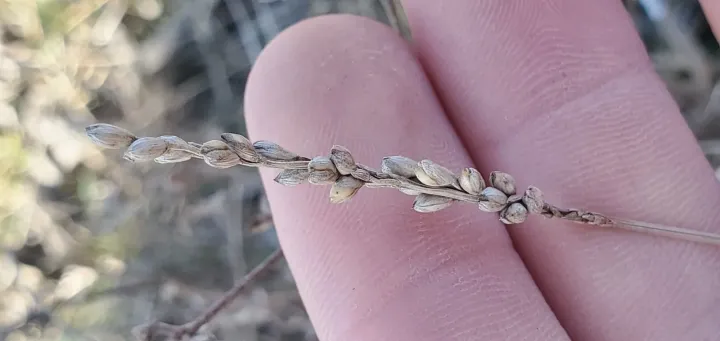
Description
Sowing dates
Sowing should be carried out in the spring when soil temperatures reach 15°C (60°F) or higher, ensuring rapid germination and early development of the root system.
Seeds should be planted at a shallow depth, typically 1 to 2 cm, as they are small and require adequate contact with soil moisture to activate the germination process.
Supplemental irrigation is recommended during the initial weeks of establishment to ensure the seedlings can develop the necessary root depth to survive the summer heat.
When establishing on rangelands, it is often sown in mixtures with other adapted native grasses to increase biodiversity and improve the stability of the stand.
Proper seedbed preparation is essential to reduce competition from invasive weeds during the sensitive early growth phases of the crop.
Growing requirements
Vine mesquite (Panicum obtusum) is a perennial stoloniferous grass belonging to the Poaceae family. It is native to the southwestern United States and northern Mexico, where it thrives in semi-arid environments.
This grass is highly adapted to sandy, loamy, and clay soils, showing excellent performance in sites that are prone to periodic flooding or water accumulation, despite its general drought tolerance.
The botanical feature defining this species is its thick, knotty rhizomes and stolons that allow the plant to spread horizontally and form dense, protective mats over the soil surface.
It prefers full sun exposure and warm growing seasons. The plant remains dormant during cold periods, resuming vigorous growth only when temperatures rise sufficiently in the spring.
In conservation, Vine mesquite is highly valued for its ability to stabilize soil in areas where other species struggle to establish due to harsh conditions or high salt content in the soil.
Main diseases and pests
The species is generally robust, but excessive moisture can lead to fungal leaf diseases that impair photosynthetic capacity and reduce overall biomass production.
Insects, particularly grasshoppers, are the most significant pests, as they can cause extensive damage to the foliage and developing seed heads during dry summers.
Root rot is a potential risk in areas with poor drainage, which can be mitigated by careful site selection and preventing prolonged waterlogging.
Management of competitive weed species is critical, especially during the first year of establishment, as the grass is a relatively slow grower in its youth.
Chemical control is rarely the first line of defense; instead, rotational grazing and maintenance of appropriate stocking rates are preferred to keep the stand healthy.
Harvesting
Vine mesquite is primarily used as high-quality forage for livestock, particularly during the active growing season when its protein content is most favorable.
For hay production, mowing should occur before the plants reach full maturity and the stems become lignified, which significantly reduces the digestibility of the feed.
A cutting height of at least 10 cm is advised to protect the nodes of the stolons, which are vital for the plant's regeneration and spread across the field.
Seed harvesting is technically challenging due to the asynchronous ripening of the inflorescences; multiple passes or specialized combines may be required.
Post-harvest residue is highly effective as a ground cover, providing long-term protection against water and wind erosion in degraded rangelands.