
Early speedwell
Veronica praecox
Description
Growing requirements
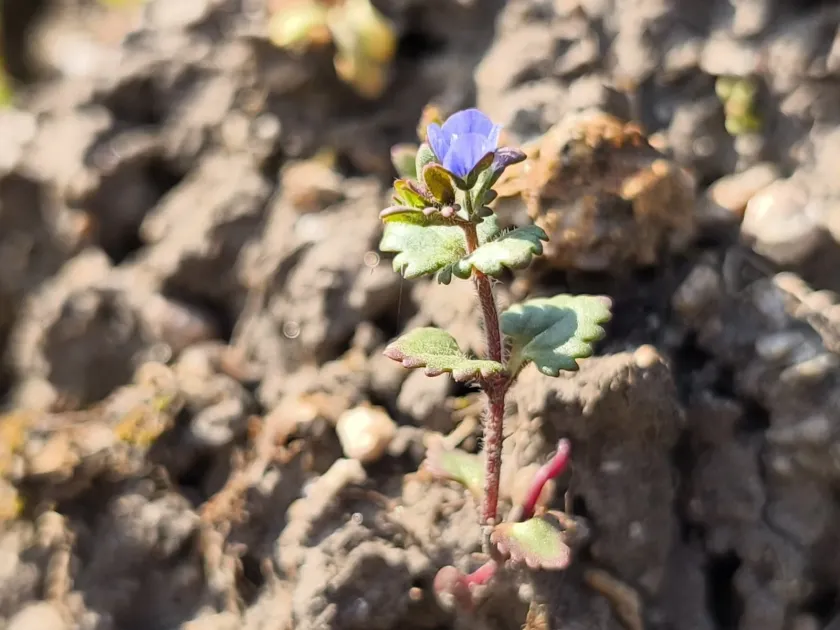
Early speedwell (Veronica praecox) is an annual herbaceous plant belonging to the Plantaginaceae family. It is typically characterized by its small stature, usually growing no more than 15 centimeters in height. Its stems are often branched at the base and covered with fine hairs, which is a common feature for many species within the genus Veronica.
The species is native to a broad range of environments across Europe, Western Asia, and North Africa. It is frequently found in open habitats, including agricultural fields, meadows, and rocky slopes. Its ability to complete its lifecycle early in the season makes it a successful colonizer in disturbed soils.
Botanically, the plant is identified by its opposite lower leaves and alternate upper leaves, accompanied by small, bright blue, or violet flowers. The floral structure is typical for the genus, with four petals forming a distinct corolla. The plant reproduces primarily through seeds, which are dispersed effectively in the late spring.
Regarding its ecological requirements, Veronica praecox thrives in well-drained, sandy, or light loam soils. It shows a clear preference for sunny, exposed locations where it can capitalize on early season sunlight before the canopy of taller crops or perennial grasses closes over, limiting the available light.
In terms of agricultural management, while it is not a commercial crop, its early growth habit makes it a common plant in fields during the early spring tillage operations. Understanding its growth cycle is essential for farmers to determine the optimal timing for field preparation and integrated weed management programs in early-planted crops.