
Thin-flowered plantain
Plantago tenuiflora
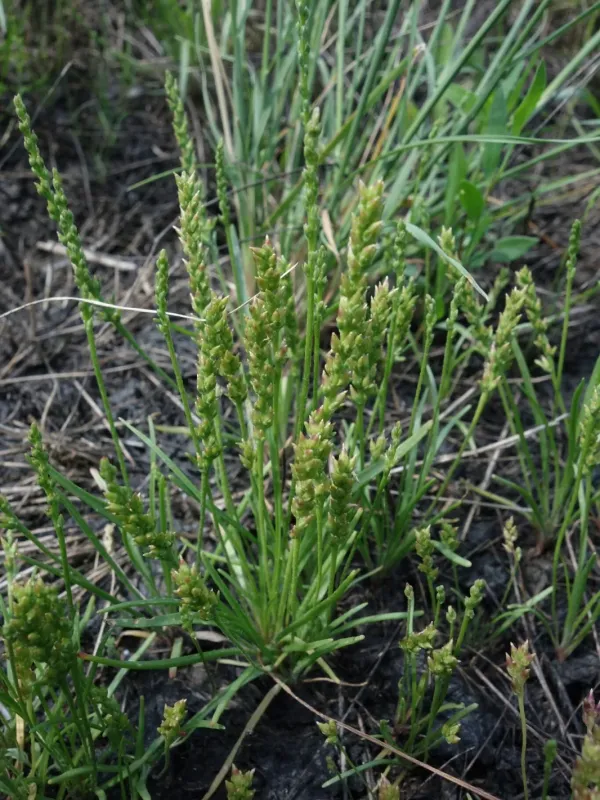
Description
Sowing dates
Thin-flowered plantain is an annual herbaceous plant whose life cycle is strictly synchronized with seasonal moisture availability. The seeds are highly resilient and require specific temperature triggers, usually occurring in early spring, to initiate germination.
In natural habitats, sowing occurs naturally as snow melts, saturating the soil with moisture. In controlled cultivation, the optimal sowing period is early spring, when soil temperatures rise to approximately 5–8 degrees Celsius, ensuring favorable conditions for seedling emergence.
Due to the small size of the seeds and their limited energy reserves, they should be sown shallowly, ideally at a depth of no more than 0.5–1 cm. Proper soil-to-seed contact is essential to prevent drying out and ensure uniform germination across the field.
Row sowing is recommended for experimental or commercial plots to facilitate space management. Keeping row spacing between 15–20 cm allows for optimal development of leaf rosettes, which later support the production of floral spikes.
The species maintains a persistent soil seed bank, allowing it to survive harsh years and re-emerge when environmental conditions become conducive. This adaptive mechanism is a key feature of its agricultural management.
Growing requirements
Thin-flowered plantain is primarily a halophytic plant, meaning it thrives in saline soils where other crops might struggle. This makes it a specialized species suitable for specific soil types, particularly in steppe and semi-arid regions.
The plant requires full sun exposure to flourish. As a heliophyte, it is highly sensitive to shading, which significantly reduces biomass accumulation and limits seed yield per individual plant.
It prefers areas with seasonal water-logging, such as the perimeters of salt lakes or low-lying depressions. While it can withstand temporary flooding, it requires a well-drained substrate during the later stages of its growth to avoid root decay.
The soil profile should be aerated, despite the inherent salinity. In dense, compacted soils with poor oxygen circulation, the taproot development is significantly inhibited, leading to stunted overall plant health.
Climatic requirements involve a stark contrast between a wet spring and a hot, dry summer. The plant completes its life cycle before the onset of the extreme summer droughts characteristic of its native habitat.
Yield
The yield of thin-flowered plantain is evaluated primarily through its seed productivity. Under optimal moisture and soil salinity conditions, the plant is capable of producing significant quantities of seeds, ensuring a robust harvest for ecological or research purposes.
Biomass production is secondary to seed yield. However, in favorable spring conditions, the plant develops dense rosettes, which can provide a considerable amount of organic matter if managed properly.
Seed yield efficiency is highly dependent on the density of the stand. In sparse populations, individual plants exhibit higher productivity, whereas in dense stands, competition for space and nutrients slightly reduces the yield per plant.
Harvesting should be timed precisely to capture the peak maturity of the spikes. Since seed maturation is often non-uniform, regular monitoring of the inflorescence is necessary to prevent significant yield losses due to natural seed shattering.
Productivity fluctuates significantly depending on annual precipitation levels. A wet spring significantly increases both the size of the plantain rosettes and the final seed harvest compared to dry cycles.
Main diseases and pests
Fungal pathogens represent the most common threat to thin-flowered plantain, particularly under conditions of high humidity. Powdery mildew can cause significant damage to the leaf tissue, weakening the plant before it sets seed.
Insect pests that target the inflorescences are a notable concern, as they can feed directly on the developing seeds. Proactive monitoring of the flower spikes during the flowering stage is essential for effective pest management.
Root rot becomes a critical issue if the plant is grown in areas with poor drainage or stagnant water during warm temperatures. This combination promotes the growth of soil-borne pathogens that target the root system.
Competition from perennial grasses can suppress thin-flowered plantain development. As an annual, it is susceptible to encroachment, so maintaining a clear field during the early growth phase is vital for a successful crop.
Environmental stressors, such as late spring frosts, can damage the floral buds. While the plant is hardy, abrupt temperature drops during the reproductive phase can lead to significant reductions in successful pollination.
Harvesting
Harvesting thin-flowered plantain is typically performed when the spikes reach full physiological maturity, indicated by a shift to a brownish color. Mechanized harvesting using combines is possible if the stand is uniform.
Post-harvest cleaning is mandatory to remove soil particles and debris. Given the saline environment, cleaning helps prevent the transmission of mineral residues that could complicate storage and long-term seed viability.
The harvested material must be dried in a well-ventilated, shaded environment. Avoid high-temperature drying or direct sunlight, as both can lead to the degradation of the seed embryos and reduced germination rates.
Storage should be conducted in climate-controlled areas with low humidity to preserve the moisture content of the seeds at safe levels. Properly stored seeds can remain viable for several years.
Maintaining records of harvest batches allows for better quality control and traceability. This practice is standard for high-value seed production and ensures consistent results in future planting seasons.