
Schleichers fumewort
Fumaria schleicheri
Description
Growing requirements
Fumaria schleicheri, commonly known as Schleichers fumewort, is an annual herbaceous plant classified within the Papaveraceae family. It is widely recognized as a significant weed in agricultural fields across Europe and parts of Asia, frequently appearing in cereal and vegetable rotations.
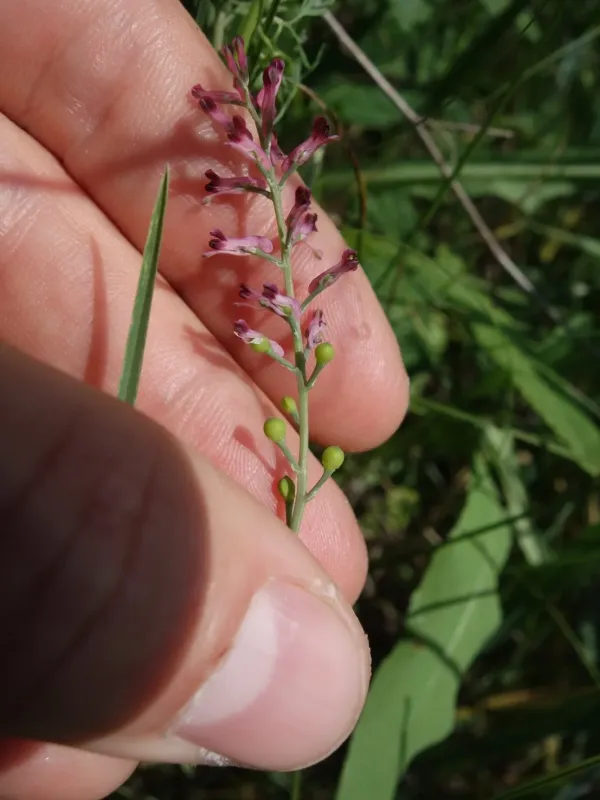
The plant is distinguished by its delicate, branched stems that grow to about 10–40 cm in height. Its foliage is finely dissected into narrow, grey-green segments. During the flowering period, it produces dense racemes of small, pink-purple flowers, which make it easily identifiable in the field landscape.
Regarding its ecological requirements, Fumaria schleicheri thrives in well-drained, fertile soils with a neutral pH. It is a light-loving species that prefers open, disturbed habitats such as arable land, roadsides, and waste areas. It is particularly competitive in early spring, utilizing moisture efficiently.
Agricultural management of this plant focuses on preventing seed dispersal, as it is a prolific producer of seeds that remain viable in the soil bank for several years. Effective control methods include mechanical tillage and the application of herbicides during early growth stages to minimize competition with main crops.
While often viewed solely as a weed, the species has a history of use in traditional herbal practices due to the presence of specific isoquinoline alkaloids. However, due to its potential toxicity to livestock if consumed in large quantities, it is primarily managed to maintain agricultural productivity and animal safety.
Main diseases and pests
Major biological threats to the species include fungal pathogens like powdery mildew, which can significantly stunt growth under humid conditions. Furthermore, the plant is susceptible to infestation by various aphids and leaf-eating beetles that can reduce the overall health and reproductive success of the population.