
Spreading spurge
Euphorbia humistrata
Description
Growing requirements
Spreading spurge (Euphorbia humistrata) is a member of the Euphorbiaceae family. Originating from North America, it has become a widespread invasive weed in agricultural landscapes across various temperate and tropical regions.
This plant prefers sunny locations with well-drained, sandy, or loamy soil. It is frequently found in cultivated fields, orchards, and gardens, where it exploits open spaces between crop rows to spread rapidly across the surface of the soil.
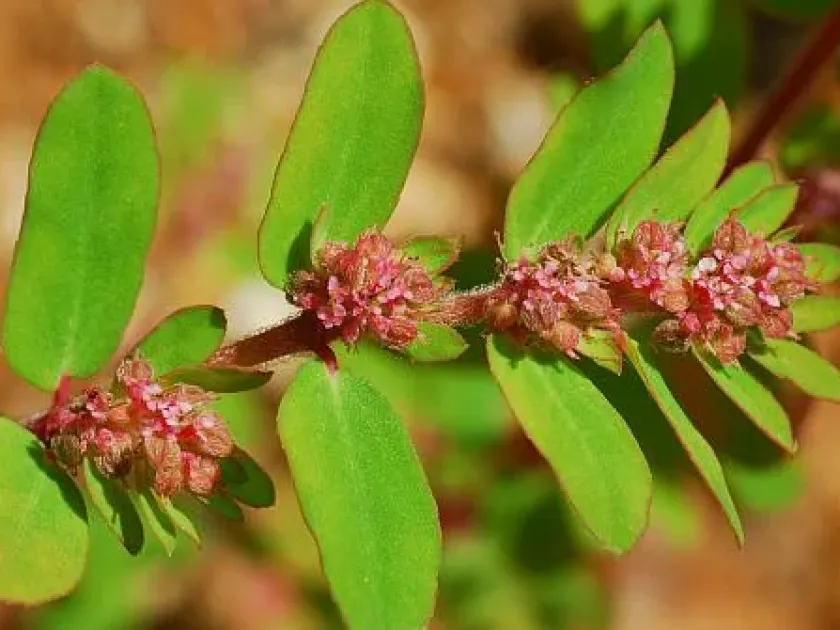
Botanically, it is recognized by its prostrate stems that grow along the ground, often reaching a length of several dozen centimeters. The stems are usually reddish and exude a milky, toxic latex when broken, which serves as a defense mechanism.
The leaves are opposite, elliptic, and often feature a reddish-brown blotch in the center, making identification easier for farmers. Its growth habit allows it to form dense mats that effectively block light from reaching the soil surface.
The plant thrives in high-temperature environments and has a high tolerance for drought once established. It requires consistent sunlight to sustain its rapid biomass accumulation, making it a major competitor in summer-grown crops.
Main diseases and pests
Spreading spurge acts as a significant competitor for water and nutrients, which can lead to measurable yield losses in row crops. Its ability to create dense ground cover makes it difficult for desirable crops to establish themselves.
The species serves as a reservoir for several plant viruses and pathogens. In agricultural settings, it can facilitate the transmission of diseases to vegetables, such as tomatoes and peppers, by hosting vectors or the pathogens themselves.
Because of its toxic milky sap, the plant has few natural insect enemies, allowing it to propagate without significant herbivory pressure. This biological advantage contributes to its success as an invasive species in managed ecosystems.
Effective management requires a combination of mechanical and chemical approaches. Cultural practices, such as maintaining high crop density and using mulch, can suppress the germination of seeds by depriving them of necessary light.
Chemical control is most successful when applied to young plants. Systemic herbicides are the preferred choice, as they ensure that the active ingredients reach the root system, preventing the plant from re-sprouting after top-growth removal.