
Prickly hornwort
Ceratophyllum muricatum
Description
Growing requirements
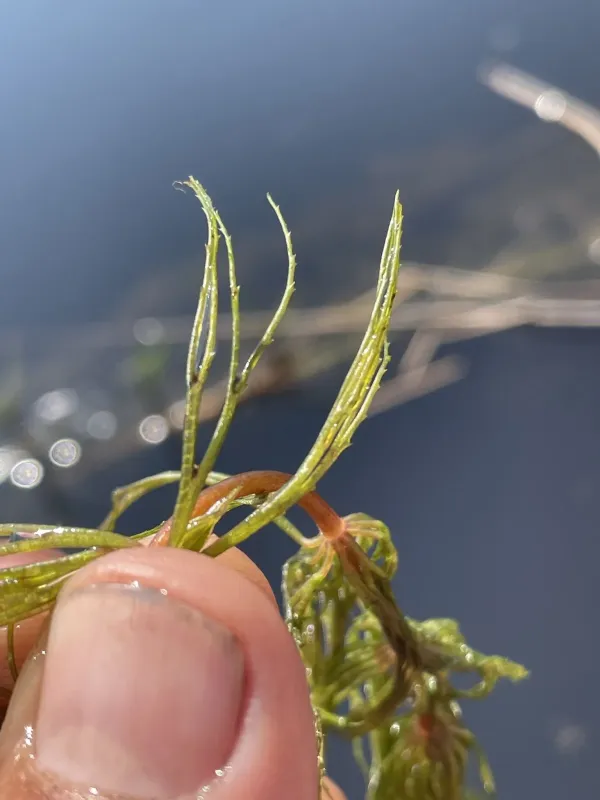
Prickly hornwort (Ceratophyllum muricatum) is a member of the Ceratophyllaceae family. It is a submerged, free-floating aquatic plant that lacks true roots, utilizing specialized branches to anchor itself to the substrate.
The native distribution of this species spans across various tropical and temperate regions globally. It thrives in stagnant or slow-moving freshwater environments enriched with organic nutrients.
In terms of environmental conditions, the plant is highly adaptable, preferring water temperatures between 18 and 26 degrees Celsius. It can tolerate low light levels, although growth accelerates under moderate to high light exposure.
Water chemistry is a significant factor for success. Prickly hornwort prefers harder, alkaline, or neutral waters where it can effectively extract necessary nutrients, thus improving overall water clarity.
Management involves simple vegetative propagation. As the plant is highly invasive in suitable conditions, it requires periodic thinning to prevent it from clogging irrigation systems or pond intakes.
Yield
The primary economic use of Prickly hornwort is in the aquaculture industry and aquarium hobby. It serves as an essential spawning medium and provides shelter for fish fry.
The plant plays a critical role in phytoremediation. It acts as an efficient biological filter by absorbing excessive nitrates and phosphates from the water column, preventing eutrophication.
In managed pond systems, it supports the local ecosystem by providing a surface for microorganisms, which are a vital part of the food web for many aquatic species.
Its high productivity makes it a subject of interest for biomass production in ecological engineering, particularly for treating agricultural runoff.
Landscape designers value the species for its ability to maintain healthy water environments in decorative ponds, provided that its growth is monitored and controlled.
Main diseases and pests
Environmental pollutants, particularly herbicides and pesticides used in nearby agricultural fields, are the most severe threats to the health of hornwort populations.
Heavy metal contamination and sudden changes in water chemistry can induce severe physiological stress, leading to tissue degradation and plant death.
Bacterial and fungal infections are common when the plant experiences thermal stress or prolonged periods of stagnant, oxygen-poor water conditions.
Certain aquatic invertebrates may graze on the delicate apical meristems of the plant, potentially slowing down its growth rate under high population densities.
Excessive turbidity caused by sedimentation inhibits light penetration, significantly reducing the photosynthetic capacity and leading to the eventual decline of the plant community.