
Larch-leaved saltwort
Salsola laricina
Description
Growing requirements
Larch-leaved saltwort (Salsola laricina) is a small semi-shrub belonging to the Amaranthaceae family. It is a highly specialized plant species adapted to survive in extremely harsh, arid, and saline environmental conditions across Central Asia.
The native habitat of this plant includes semi-deserts and deserts where high soil salinity and low precipitation levels make conventional farming impossible. It plays a vital role in local ecosystems as a primary producer and soil stabilizer.
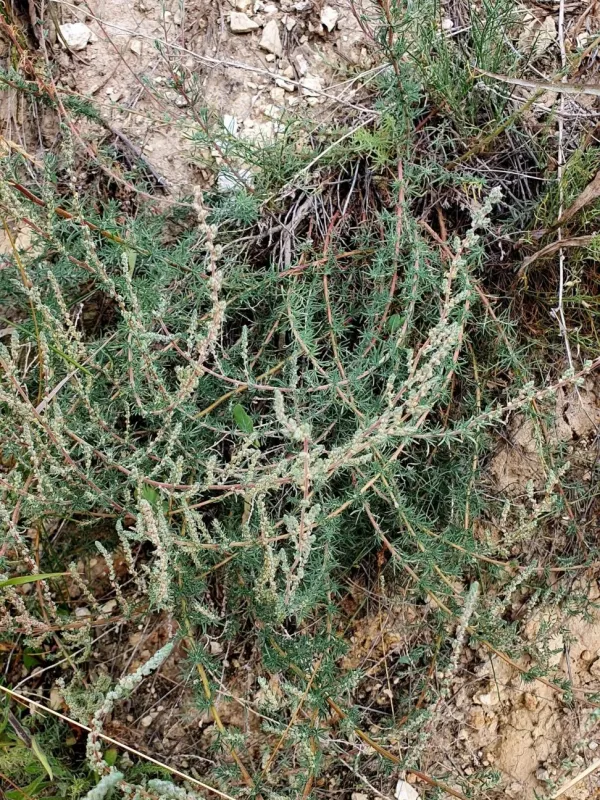
Botanically, Salsola laricina is characterized by its significant xerophytic and halophytic traits. Its stems and leaves are adapted to minimize water loss, while its root system can penetrate deep into the ground to reach hidden water tables.
The requirements for growth are specific: it demands well-drained, saline, or alkaline soils and a significant amount of solar radiation. It is highly sensitive to waterlogging, as excessive moisture can easily cause root rot and plant mortality.
In terms of agricultural management, this plant is primarily used for land reclamation and as a reliable source of forage. It is incredibly efficient at preventing wind erosion, making it a sustainable choice for restoring damaged arid landscapes.
Yield
The primary economic value of Salsola laricina lies in its forage potential for camels, goats, and sheep. During the scorching summer months, when most grasses wither, the saltwort remains a green and nutrient-dense resource.
The biomass yield varies depending on local rainfall and soil salinity levels. In optimal natural range conditions, the dry matter yield can support sustainable grazing patterns that would otherwise be unproductive in the desert environment.
The plant is rich in protein and essential minerals that are crucial for livestock health in arid zones. Studies indicate that it provides important dietary balance, helping animals maintain their physiological functions even under severe drought stress.
Effective management requires rotational grazing strategies to ensure the plants have time to recover and reseed. When managed correctly, it can provide stable forage production over several years without the need for additional irrigation.
By promoting the growth of Salsola laricina, farmers can optimize their use of marginal lands, turning arid desert areas into productive grazing grounds that support local livestock economies while protecting the environment.
Main diseases and pests
Despite its resilience, Salsola laricina can be affected by certain pests, particularly desert locusts and various species of coleoptera that feed on its stems and foliage, causing localized damage to the canopy.
Fungal diseases are rare in the wild due to the dry environment, but in experimental cultivation with high density, some root-pathogenic fungi can emerge if the soil remains damp for extended periods, stressing the plant's natural immunity.
Overgrazing is the most significant threat to the survival of these stands. When livestock remove too much biomass during the growing season, the plant cannot store enough energy to survive the winter or produce sufficient seeds for next year.
Competition from invasive xerophytic shrubs can sometimes displace the saltwort if soil nutrient levels change or if fire events alter the habitat, although Salsola laricina is generally well-adapted to surviving its natural range disturbances.
To mitigate these threats, agronomists recommend monitoring the density of the stands and implementing seasonal grazing restrictions, ensuring that the ecological balance of the arid pasture is maintained for future use.