
Salix acmophylla
Salix acmophylla
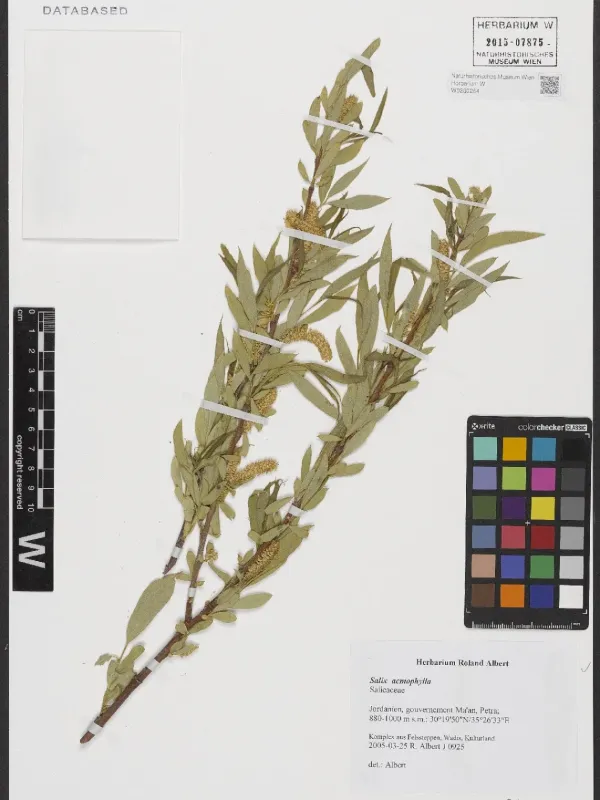
Description
Sowing dates
Propagation of Salix acmophylla is primarily achieved through vegetative means, using dormant cuttings. The optimal time for planting is early spring, just before the growing season commences, to ensure the cuttings establish root systems before the heat of summer.
Cuttings should be selected from healthy, one-year-old shoots, typically 20–30 cm long. They are planted into well-prepared, loose soil, ensuring that at least two buds remain above the ground to facilitate future branch development and plant growth.
The spacing of the plants depends on the intended usage. For commercial willow production, denser planting schemes are employed to encourage vertical growth and limit side branching, which is essential for obtaining high-quality straight rods.
During the initial phase, providing adequate soil moisture is critical. The area should be kept free of weeds to prevent competition for light and nutrients, as young willow plants are sensitive to competition during their establishment period.
Proper soil compaction around the base of the cutting is necessary to avoid air pockets, which could desiccate the developing root system. Consistent maintenance of moisture levels during the first months ensures higher success rates in plantation establishment.
Growing requirements
Salix acmophylla, a member of the Salicaceae family, is a highly adaptable species that thrives in various conditions. It is particularly well-suited to alluvial soils found in river floodplains, where consistent moisture levels are naturally available.
This species is exceptionally photophilous, requiring full sun for optimal development. Exposure to shade can negatively impact the growth rate and structural integrity of the wood, making it less suitable for high-value technical applications.
While Salix acmophylla is known for its tolerance to various soil types, it performs best in soils with high fertility and good water retention. It can also adapt to moderately saline conditions, showcasing its ecological plasticity across diverse regions.
Climate-wise, the species is resilient to fluctuations in temperature, making it suitable for cultivation across different latitudinal ranges. Its ability to withstand environmental stress contributes to its reliability as a perennial agricultural crop.
The root system of Salix acmophylla is extensive, which serves to improve soil structure and prevent erosion. This makes it an ideal candidate for phytoremediation projects and landscape stabilization efforts in sensitive ecological zones.
Yield
The economic value of Salix acmophylla is primarily derived from its high-quality biomass, which serves multiple industries. In traditional sectors, it is a key material for basketry, furniture making, and artisanal weaving due to its flexibility.
Yield capacity is high when managed through intensive coppicing methods. Regular harvesting of shoots stimulates the plant to regenerate vigorously, providing a sustainable, multi-year supply of rods from the same established rootstock.
In the energy sector, Salix acmophylla is utilized as a source of renewable biomass for biofuels. Short-rotation forestry practices allow for consistent harvesting cycles, contributing to local energy security and reducing dependence on fossil fuels.
Beyond material production, the crop provides significant ecosystem services. The dense biomass acts as an effective windbreak, protecting other agricultural crops from wind damage and improving the microclimate of the farm environment.
Effective plantation management involves careful planning of harvest cycles, ensuring that the biomass reaches the desired maturity for its intended end-use, whether as fine raw material for crafts or industrial wood chips for power generation.
Main diseases and pests
Salix acmophylla faces challenges from various pests, including leaf beetles and willow gall midges. These pests can significantly reduce foliage density and weaken the plant, leading to stunted shoot growth and decreased biomass quality.
Fungal diseases like rust and various leaf spot pathogens can pose a threat, particularly in humid climates or areas with poor air circulation. These infections weaken the wood and can lead to lower yield if left unmanaged.
Integrated pest management (IPM) is recommended to control threats while minimizing environmental impact. This includes selecting resistant cultivars, ensuring optimal site drainage, and maintaining healthy plantation hygiene through regular inspections.
- Willow leaf beetle
- Willow gall midge
- Rust fungus
- Powdery mildew
- Canker diseases
Proactive management remains the best defense. A well-nourished, appropriately spaced plantation demonstrates strong natural resistance, reducing the necessity for chemical intervention and promoting sustainable agricultural practices.
Harvesting
Harvesting of rods for artisanal use is typically conducted during the dormant season, from late autumn to early spring. This timing ensures the material has the necessary strength and elasticity for processing and bending without snapping.
For industrial biomass production, mechanical harvesters are used to cut the shoots at the base. This method is highly efficient, allowing for the rapid processing of large areas and maximizing the volume of wood chips produced per hectare.
Post-harvest handling is critical for maintaining quality. Material intended for weaving must be stored in well-ventilated, shaded areas to prevent drying out and losing the flexibility that makes Salix acmophylla a prized commodity.
Grading and sorting of the harvested material based on length and diameter add value to the final product. Consistent quality control ensures that the crop meets the diverse requirements of the craft and industrial manufacturing markets.
The sustainability of Salix acmophylla as a crop is bolstered by its ability to regenerate year after year. With proper coppicing and soil management, plantations can remain productive for several decades, offering long-term agricultural stability.