
Fremont cottonwood
Populus fremontii
Description
Growing requirements
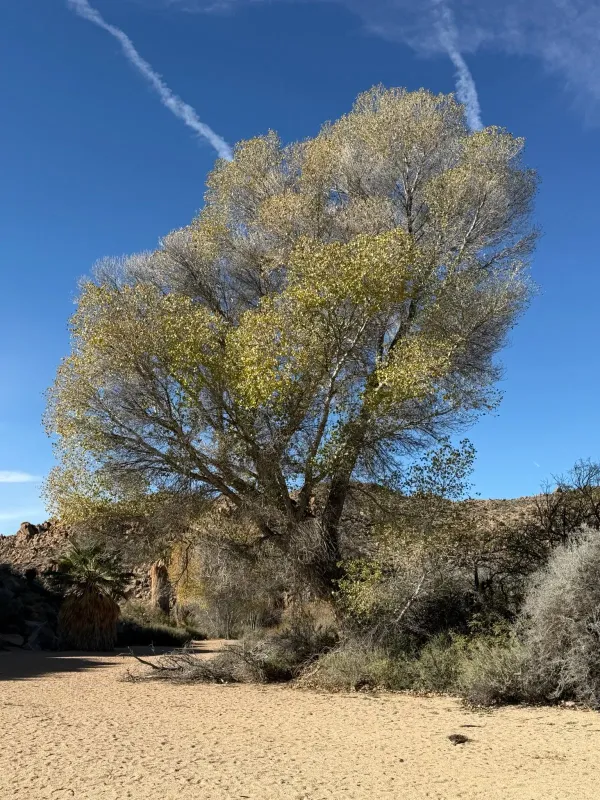
Fremont cottonwood (Populus fremontii) is a fast-growing deciduous tree belonging to the Willow family (Salicaceae), recognized for its rapid biomass accumulation.
The native range of this species covers the southwestern United States and northern Mexico, where it typically dominates riparian corridors, riverbanks, and floodplains.
This tree is highly dependent on accessible water tables, as its root system is specialized for extracting moisture from alluvial soils common in river valleys.
Fremont cottonwood exhibits strong phototropism and requires full sun exposure to maintain healthy foliage and optimal growth rates during the vegetative season.
It prefers deep, moist, well-drained soils and shows remarkable tolerance to a wide range of soil textures, provided that moisture levels remain consistent.
Yield
In agricultural and forestry contexts, this species is frequently cultivated as a source of rapid biomass for pulpwood, packaging materials, and paper production.
The wood quality is characterized as lightweight and soft, which makes it suitable for secondary manufacturing applications rather than structural load-bearing projects.
Besides industrial wood production, the tree serves as an essential component in land reclamation projects, specifically for soil stabilization and watershed protection.
Modern management practices involve short-rotation coppice systems, where the trees are harvested periodically to maximize the annual output of woody biomass.
Due to its ecological significance, the tree is also utilized in restoration ecology to restore disturbed riparian habitats and support local biodiversity.
Main diseases and pests
The species is susceptible to various fungal pathogens, such as Cytospora canker and leaf rust, which often strike trees under physiological stress or poor drainage.
Wood-boring insects are significant pests that create galleries in the trunk and branches, severely compromising the structural integrity of the tree over time.
Defoliating insects, including certain species of beetles and caterpillars, can cause significant canopy thinning, leading to reduced photosynthetic capacity.
Human-induced changes to river hydrology, such as damming and water diversion, remain the most significant environmental threat to the sustainability of this crop.
Invasive weed encroachment represents a major challenge during the seedling establishment phase, requiring active weed control to ensure successful plantation development.