
Himalayan Poplar
Populus ciliata
Description
Growing requirements
Himalayan Poplar (Populus ciliata) is a large deciduous tree belonging to the Salicaceae family. It is native to the Himalayan region, spanning across countries like India, Nepal, Pakistan, and parts of China. This tree is primarily found in mountainous terrains at altitudes ranging between 1500 and 3500 meters above sea level.
The species thrives in cool, moist environments and requires fertile, well-drained alluvial soils to reach its full potential. While it favors high humidity, it is intolerant of waterlogged soil conditions, which can lead to root system decay. Planting on slopes with consistent, natural moisture drainage is recommended.
Regarding climate, Populus ciliata is well-adapted to mountain environments, characterized by moderate summers and cold winters. It is a light-demanding species, often acting as a pioneer plant in forest clearings. Its rapid growth rate makes it a popular candidate for reforestation projects in its native range.
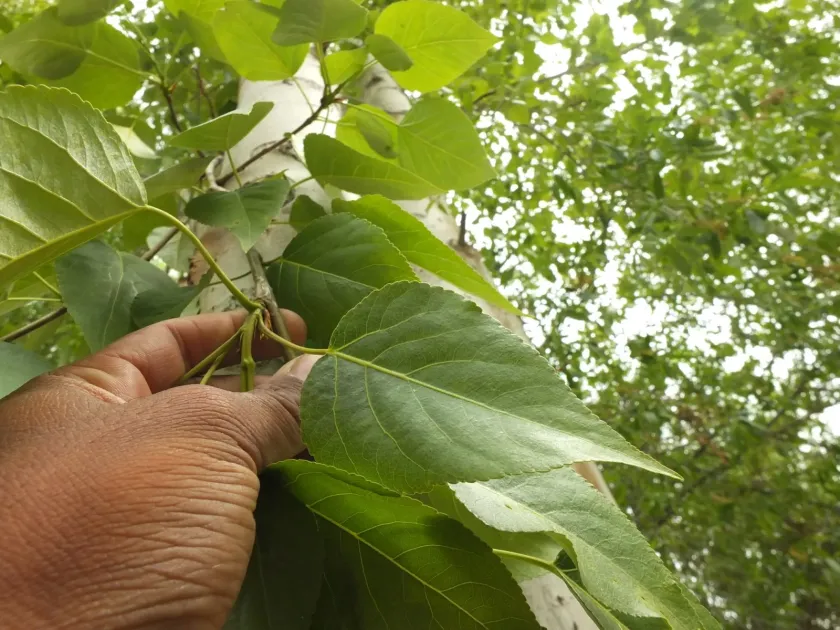
Botanically, it is defined by its ovate-cordate leaves with distinct ciliated (fringed) margins, from which it derives its specific epithet. The tree can reach heights of up to 30 meters. It possesses a robust root system that plays a crucial role in soil stabilization, making it valuable for managing erosion on steep mountain hillsides.
In economic terms, the wood of the Himalayan Poplar is light and soft, commonly used in the manufacture of veneer, plywood, matchsticks, and various types of packing crates. Furthermore, the tree is frequently utilized in agroforestry for windbreaks and as a sustainable source of timber for local mountainous communities.
Main diseases and pests
Himalayan Poplar is susceptible to several fungal diseases, most notably leaf rusts caused by Melampsora species. During periods of excessive humidity, bacterial cankers can infect the bark, leading to significant structural weakness and potential death of the specimen if not managed properly.
Pests typically include leaf-feeding beetles, various species of caterpillars, and the poplar moth. Wood-boring insects, such as longhorn beetles, pose a structural threat by creating tunnels in the heartwood, which significantly diminishes the quality of timber produced for commercial purposes.