
Hall's totara
Podocarpus cunninghamii Colenso
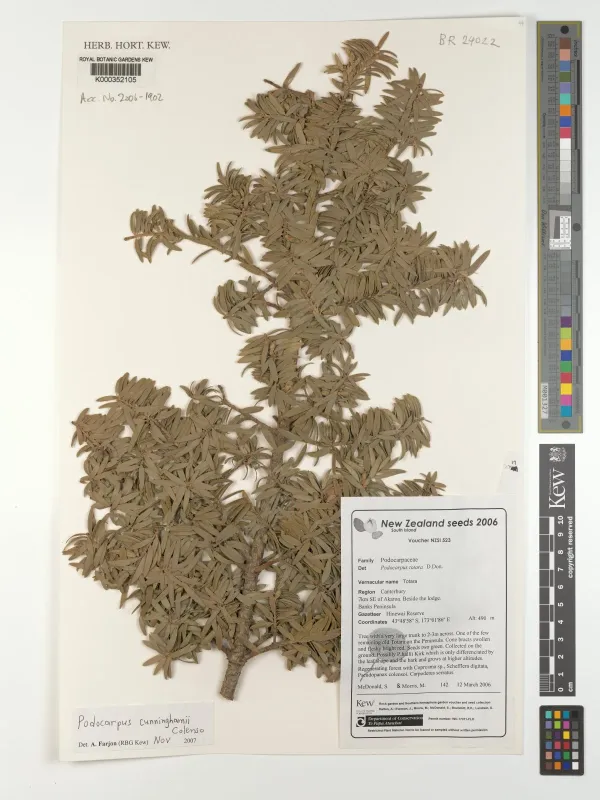
Description
Growing requirements
Hall's totara is a hardy coniferous species belonging to the Podocarpaceae family, native to the high-altitude forests of New Zealand.
The plant thrives in cool, temperate climates and is well-adapted to high-rainfall areas, reflecting its evolution in alpine and subalpine environments.
It prefers deep, well-drained, acidic soils and is sensitive to waterlogging, which can cause rapid decline in the plant's root system health.
Botanically, it is distinguished by its small, needle-like leaves and slow growth rate, making it a long-lived tree in stable forest ecosystems.
Successful cultivation requires site selection that provides protection from excessive heat and direct drying winds while ensuring adequate light exposure.
Yield
The wood of Podocarpus cunninghamii is historically valued for its durability and fine grain, though it is currently managed under strict sustainable harvesting practices.
In modern landscape architecture, the species is favored for its architectural form and evergreen foliage, often used as an ornamental specimen in temperate gardens.
Yield estimation for forestry applications is based on a long rotation cycle, as the tree requires several decades to reach harvestable dimensions.
Seed production is a critical stage in the nursery cycle, but the irregularity of heavy seed years necessitates advanced collection techniques for consistent propagation.
Sustainable use of the species focuses on restoration ecology, where it is used to enrich biodiversity in secondary forest successions.
Main diseases and pests
Pathogenic fungi, particularly Phytophthora species, present a significant threat to saplings if the soil drainage is not properly maintained.
Scale insects and various mite species can infest the foliage, resulting in yellowing and stunted growth if left untreated in intensive nursery settings.
Browsing by feral animals like deer and possums poses a major threat to young plants, often requiring the use of physical barriers for protection.
Needle cast diseases can occur in crowded or humid conditions, necessitating regular monitoring and improved air circulation around the canopy.
Environmental stress caused by climate change, specifically unseasonable drought, can render the trees more susceptible to opportunistic pathogens and pests.