
Aframomum strobilaceum
Aframomum strobilaceum
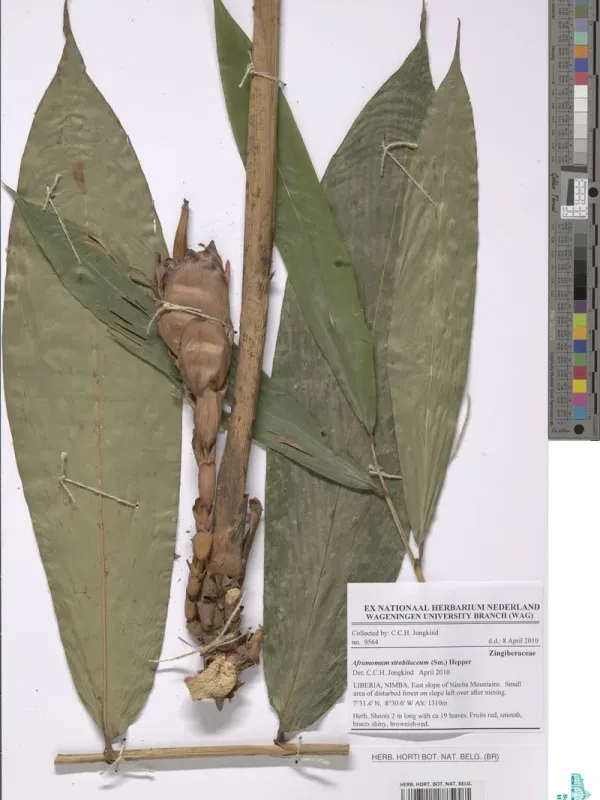
Description
Growing requirements
Aframomum strobilaceum is a perennial herbaceous plant belonging to the Zingiberaceae family. Native to the tropical regions of Africa, it is closely related to ginger and cardamom species.
The plant thrives in a high-humidity environment with consistent tropical temperatures. It requires a stable climate and performs best in areas with high rainfall and minimal temperature fluctuations.
Soil requirements include rich, organic-matter-laden substrates that provide excellent drainage. The plant is prone to root rot if waterlogged, so a porous soil structure is essential for development.
Shade management is critical, as this species is adapted to forest floors. Cultivation must provide diffused light or artificial shading to prevent leaf scorching and stress during intense heat.
Agricultural practices involve mulching to preserve soil moisture and nutrient density. Given its tropical nature, supplemental organic fertilizers are recommended to boost foliage growth and flowering capacity.
Harvesting
The harvest cycle centers on the fruit, which often develops near the base of the plant. Harvesting is typically done manually once the fruits exhibit specific maturation indicators such as color change.
Post-harvest processing involves cleaning the fruit and carefully drying the seeds. Drying must be slow and uniform to ensure that the volatile essential oils, which define the spice's quality, are preserved.
In terms of usage, the seeds serve as a potent condiment and a source of active compounds for herbal medicine. The flavor profile is noted for its intensity, often compared to high-grade cardamom.
Effective storage requires airtight and cool conditions to protect the final product from oxidation. Proper handling ensures the spice maintains its market value throughout the distribution chain.
Market demand for Aframomum strobilaceum is driven by the growing interest in niche spices. Global agricultural producers are focusing on sustainable harvesting methods to maintain plant population health.