
Foster's Iris
Iris fosteriana
Description
Growing requirements
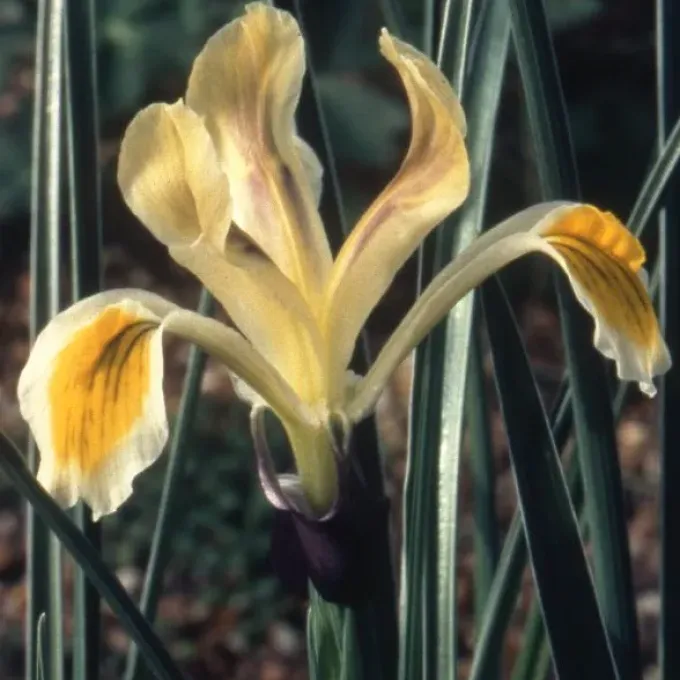
Foster's Iris (Iris fosteriana) is a distinctive member of the Iridaceae family, recognized for its botanical uniqueness and specific adaptation to arid mountainous environments. It is native to the regions of Turkmenistan and Northern Iran, where it thrives in rocky, well-drained soils.
The plant is categorized as a bulbous iris, typically growing to a height of 15–20 cm. Its foliage is highly decorative, featuring sickle-shaped leaves with a noticeable white margin. These leaves emerge early in the season, often preceding the flowers, creating an elegant visual profile in the early spring garden.
Requirements for cultivation are stringent, particularly regarding soil composition. The substrate must offer excellent aeration and drainage. Heavy, clay-based soils should be avoided or amended with grit and coarse sand to prevent moisture retention that causes bulb rot.
Regarding climate, this species prefers full sun exposure and dry summers. The dormancy phase during the hot summer months is essential for the bulb to mature and ensure blooming for the subsequent season. Artificial irrigation during this period should be strictly prohibited to prevent physiological stress.
Agricultural management requires attention to the seasonal cycle. In early spring, moderate watering supports growth, but as the foliage begins to senesce post-flowering, the soil must be kept completely dry. This mimics the natural rainfall patterns of the species' native mountainous habitat.
Main diseases and pests
The primary threats to Iris fosteriana are fungal pathogens, specifically those causing bulb and basal rot. Overwatering and poor soil drainage create a high-risk environment for Fusarium species, which can decimate a collection rapidly if not addressed with fungicides.
Leaf spot diseases, often caused by Botrytis or Heterosporium, can appear in humid spring conditions. These pathogens manifest as discolored lesions on the foliage, and if left untreated, they can spread rapidly through the patch, significantly reducing the plant's photosynthetic capacity.
Pests such as aphids and spider mites are common adversaries during the active growing phase. Aphids, in particular, can transmit viral infections that cause mosaic patterns on the leaves, leading to irreversible loss of vigor and stunted development of the flowering stalk.
Bulb mites represent a subterranean threat, frequently attacking damaged or weakened bulbs. Prophylactic dipping of bulbs in specialized miticides prior to planting is a standard best practice for maintaining healthy stock and ensuring a strong start to the season.
Overall plant health is highly dependent on environmental hygiene. Removing dead plant debris at the end of the season and ensuring adequate spacing between bulbs will significantly reduce the inoculum load for recurring diseases and minimize the spread of common garden pests.