
Agave marmorata
Agave marmorata Roezl
Description
Growing requirements
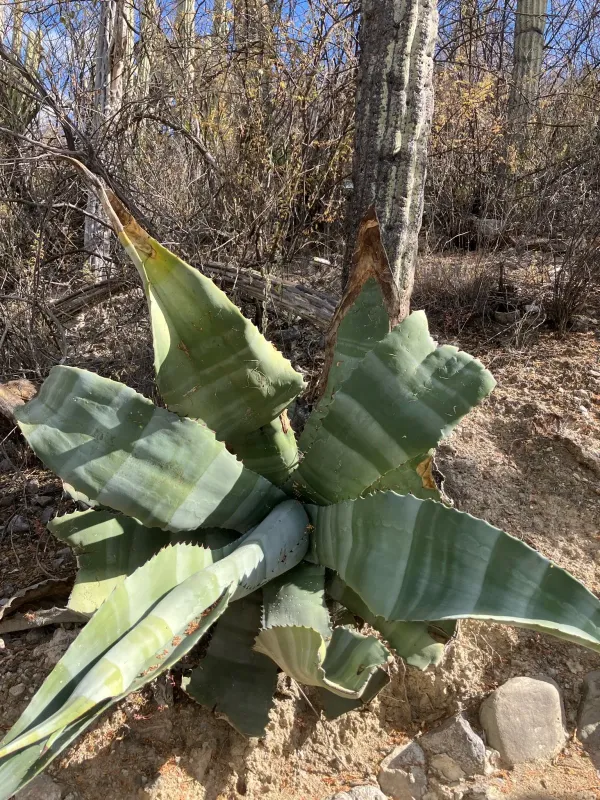
Agave marmorata, commonly known as the marble agave, is a perennial succulent belonging to the Agavaceae family. It is native to the arid mountainous regions of Oaxaca, Mexico, where it has evolved to thrive in rocky and nutrient-poor substrates.
The plant is distinguished by its impressive rosette of thick, fleshy leaves, which feature striking cross-banding patterns resembling marble. The leaves are lined with sharp, sturdy spines, making it both an ornamental piece and a hardy specimen in xeriscape gardening.
To succeed in cultivation, this plant requires full sun exposure and excellent drainage. It is highly sensitive to humidity and waterlogged soil, which can rapidly lead to tissue degradation and rot. A gritty, well-draining potting mix is essential for pot-grown specimens.
Temperature tolerance is a key consideration, as the plant prefers warm, dry days and cool nights. It is not frost-tolerant and must be protected in colder climates. In terms of water, it requires deep but infrequent watering during the growing season, while remaining dry during winter dormancy.
Agricultural management involves monitoring the growth rate and ensuring the plant has enough space to expand. Since it grows relatively slowly, minimal fertilization is required—usually once a year during the peak spring growth phase using a balanced fertilizer.
Main diseases and pests
The most significant threat to Agave marmorata is root rot caused by moisture retention in the soil. Over-watering creates an anaerobic environment that destroys the root hairs and prevents the plant from absorbing necessary nutrients.
Pests such as mealybugs and scale insects represent a persistent challenge for growers. These pests hide in the crevices between leaves, where they are protected from topical treatments, often requiring systemic insecticides for complete eradication.
Agave snout weevils are particularly lethal, as their larvae bore into the core of the plant. Once an infestation is visible on the surface, the plant is often already beyond recovery, making proactive monitoring and barrier methods essential for survival.
Fungal infections, often presenting as dark spots or leaf softening, occur primarily in environments with poor air circulation. Improving ventilation around the plants is a crucial cultural practice to prevent the spread of these pathogens during humid seasons.
Mechanical damage to the leaves, caused by improper handling or animal pests, can also serve as an entry point for bacteria. Keeping the plant in a clean environment and treating any wounds with fungicide or sulphur powder helps maintain overall plant health.